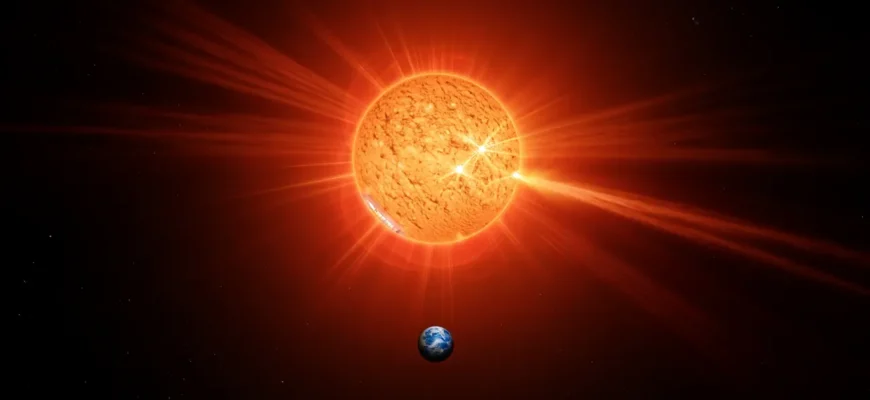
In recent years, solar activity has increased, and the number of magnetic storms has grown rapidly. Could the Sun explode in the near future, and what would happen to humanity in such a scenario?
- When Will the Sun Explode?
- The Evolution of the Sun
- 1. Birth
- 2. Main Sequence Stage
- 3. Red Giant Stage
- 4. Planetary Nebula and White Dwarf—The Star’s Death
- What If the Sun Exploded?
- What Would Happen to the Sun?
- Interesting Facts About the Sun
- How Big Is the Sun?
- How Fast Does the Sun Rotate?
- Sun’s Composition
- Sun’s Temperature
- Sun’s Color
- What Causes Magnetic Storms?
- Will the Sun Swallow Earth?
When Will the Sun Explode?
The years 2024-2025 have been marked by extreme solar activity. The agitated Sun shoots streams of plasma, bombarding Earth with electromagnetic particles, triggering magnetic storms and unplanned auroras in latitudes where they shouldn’t appear.
These events have spawned numerous theories, including apocalyptic ones: the Sun’s activity will intensify, leading to powerful flares that could disrupt Earth’s magnetic field, satellite operations, electronic devices, the internet, and communication networks. Similar phenomena were observed in the summer of 2024 when voltage fluctuations occurred in power grids, and navigation systems malfunctioned, affecting air travel. Researcher Sangeetha Abdu Jyothi predicted in 2021—when solar processes were already alarming scientists—a potential technological catastrophe in 2025, estimating that a single day of internet disruption would cost the U.S. $7 billion. In 2024, many recalled her prediction, though she had estimated the probability of such a scenario at just 1.6%.
After studying solar flares in 2024 and early 2025, most scientists concluded that the peak of the Sun’s activity has passed. Powerful flares will still occur this year but much less frequently, and by the end of 2025, solar activity should return to normal. In other words, everything is following the usual 11-year solar cycle.
Our Sun will continue shining for at least another 5 billion years—and according to some estimates, up to 7-8 billion years.
Yet, the current situation has raised many questions, the most pressing being: When will the Sun explode, and what would happen to humanity afterward?
For the next few million years, there’s no need to worry—the Sun cannot explode in the way we typically imagine. There are several reasons for this:
- Thermonuclear reactions occur at specific temperatures and pressures, burning hydrogen, which makes up 72% of the Sun (and there’s still plenty left). However, the resulting helium slows down fusion, preventing the star from exploding.
- The Sun’s gravity counteracts explosive forces, balancing them.
- Like other stars, the Sun has negative heat capacity—if the core temperature rises, the star expands, reducing gravity and causing it to cool until it eventually fades.
Thus, our Sun won’t explode—it faces a different fate.
The Evolution of the Sun
The Sun is a yellow dwarf star located in the Milky Way galaxy, not at the center but on the periphery. If we imagined the Sun as a person, it would be about 30 years old—not a capital city resident but more like living in a regional town. The Sun is among the 15% brightest stars in the galaxy but pales in comparison to the brightest. The remaining 85% are dimmer stars—white, red, and brown dwarfs—emitting far less light and heat.
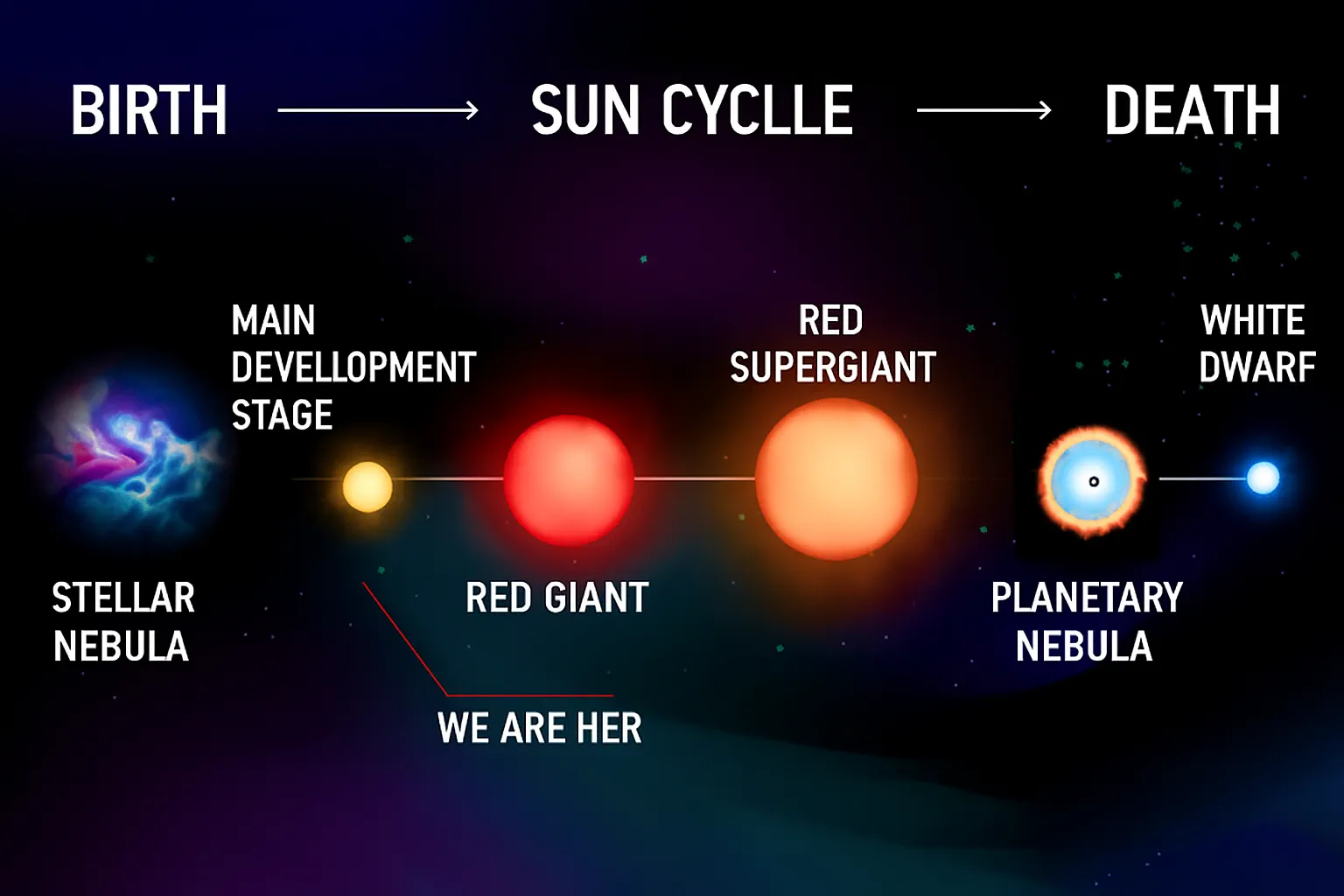
Like all stars, our Sun has a life cycle consisting of the following stages:
1. Birth
Stars form from vast molecular clouds of gas and dust called stellar nurseries. The gases—mostly hydrogen and helium—are remnants of supernova explosions, which give birth to new stars. The Sun is considered a third-generation star, meaning two previous generations synthesized the elements needed for its formation. The cloud contracts, heats up, and begins glowing, resisting gravity. As it compresses, a dense core forms, surrounded by a disk of gas and dust—material that later forms planets and asteroids, including Earth. This protostar’s temperature rises until thermonuclear fusion of hydrogen into helium begins.
2. Main Sequence Stage
This is the Sun’s current phase. Every second, 6 million tons of hydrogen fuse into helium, releasing enormous energy. Over time, helium accumulates, burning more hydrogen and increasing luminosity. Calculations show the Sun brightens by 10% every billion years. In 1 billion years, Earth will experience a runaway greenhouse effect like Venus. In 4 billion years, the Sun will be 40% brighter, boiling away Earth’s water and turning it into a scorched desert. Humanity won’t witness the Sun’s later stages.
3. Red Giant Stage
In 5-6 billion years, the Sun’s core will exhaust its hydrogen, heat up, and compress, causing the star to expand into a red giant. It will likely engulf Mercury and Venus—and possibly Earth.
4. Planetary Nebula and White Dwarf—The Star’s Death
Helium will fuse into carbon over 100 million years. The dying Sun’s outer layers will pulsate, shedding material to form a nebula lasting ~10,000 years before dissipating. The core will remain as a hot, dense carbon white dwarf—Earth-sized but with a mass equal to the Sun’s (a sugar-cube-sized piece would weigh 2.5 tons). Over trillions of years, it will cool into a black dwarf—a dark, inert remnant.
Note: Black dwarfs remain hypothetical, as the universe (13.7 billion years old) hasn’t existed long enough for any to form (requiring ~10 trillion years).
What If the Sun Exploded?
Though impossible, scientists have theorized scenarios:
First scenario: An explosion would release enough energy to obliterate all life. Water would vaporize, and Earth would become a barren wasteland before freezing solid at -160 °C.
Second scenario: Humanity would perish slowly but painfully.
- The blast would emit lethal radiation, destroying the ozone layer. All life would die from exposure.
- Radiation would kill plants, halting photosynthesis. Oxygen levels would plummet, suffocating animals and humans.
- Without plants, herbivores would die, followed by predators.
- Food supplies would run out within a year, causing global famine.
- Power grids would fail, cutting electricity, heat, and clean water. Disease outbreaks would follow.
Human civilization would last no more than a year.
An explosion could also alter Earth’s orbit, ejecting it from the solar system as a rogue planet—sterilizing all remaining life.
Researchers see only one solution: Humanity has ~1 billion years to find a new home. One candidate is Proxima b, an Earth-like planet orbiting red dwarf Proxima Centauri.
What Would Happen to the Sun?
After the red giant stage, when the Sun will most likely absorb almost all the planets of the Earth group, it will turn into a white dwarf. Uranus and Neptune will leave the solar system, as the Sun will not be able to hold them with its gravitational force.
And there will be no explosion. Only large stars, whose mass exceeds ours many times over, explode. After such an explosion, called a supernova, shining with the brightness of 10 billion suns, either a black hole or a neutron star will remain in place of the star — an object so dense that with a diameter of 20 km, it will exceed our star in weight several times over. But the Sun is not threatened by such a process.
Interesting Facts About the Sun

How Big Is the Sun?
The largest known star, UY Scuti, is 1,700 times wider. Yet, the Sun accounts for 99.8% of the solar system’s mass (2 nonillion kg—a 2 followed by 30 zeros). It’s 333,000 times heavier than Earth. If hollow, over a million Earths could fit inside. Its gravity is 28 times stronger than Earth’s.
How Fast Does the Sun Rotate?
Since the star consists mainly of hydrogen, its parts rotate around their axis at different speeds: at the equator, one rotation takes 25 days, and at the poles, 36 days. The Sun revolves around the center of the Milky Way galaxy at a speed of 217 km/s. It completes one revolution in approximately 240 million years — this period is called a galactic year.
Sun’s Composition
The star consists of hydrogen (72%), helium (27%), and dozens of other chemical elements, predominantly oxygen and carbon.
Sun’s Temperature
The hottest part of the star is its core, which reaches temperatures of 15 million degrees Celsius. The surface of the Sun is much cooler, at around 5,500°C (5,780 Kelvin). The dark spots on the surface are areas with lower temperatures, called coronal holes. It is noteworthy that the temperature in the solar atmosphere does not decrease with altitude, as it does on Earth, but increases, reaching 2 million degrees. In addition to heat, the Sun emits constant streams of charged particles called solar wind. Its speed is approximately 450 km/s, and it spreads throughout the solar system. Sunlight reaches the Earth’s surface in 8 minutes and 20 seconds.
Sun’s Color
Although we paint the sun yellow, it is actually white, and it appears yellow to us because of the atmosphere, which scatters the rays and gives it color.
What Causes Magnetic Storms?
Solar flares cause magnetic storms. The strongest magnetic storm in Earth’s history was recorded on September 1-2, 1859, when telegraph systems around the world went down and the aurora borealis lit up the skies across the planet, even being observed by residents of the Caribbean islands.
Will the Sun Swallow Earth?
In ~5 billion years, the red giant Sun may engulf Earth—but life will already be impossible in ~1 billion years due to rising temperatures (+47 °C average).