How quickly these celestial bodies form and what happens to them next.
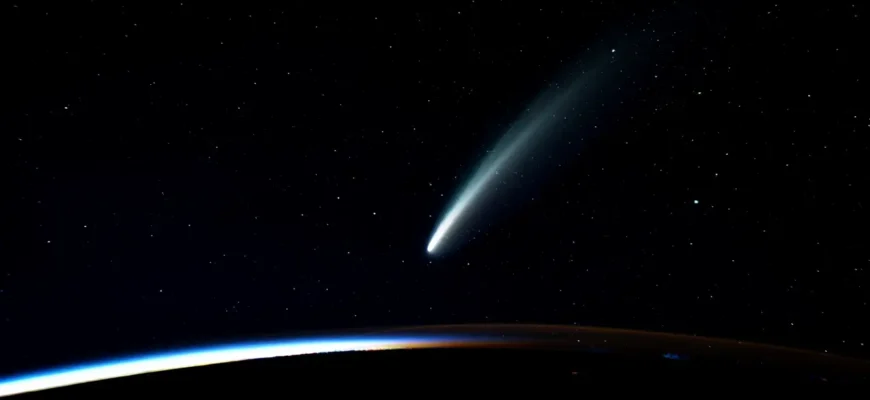
In April 2026, we had the opportunity to see a cosmic traveler. Comet C/2025 R3 (Pan-STARRS), which arrived from the Oort Cloud — a giant icy “graveyard” on the outskirts of the Solar System — made its closest approach to the Sun on April 20, and a week later it will fly past Earth at a distance of 71 million km. Here is where these celestial guests come from.
How comets are born
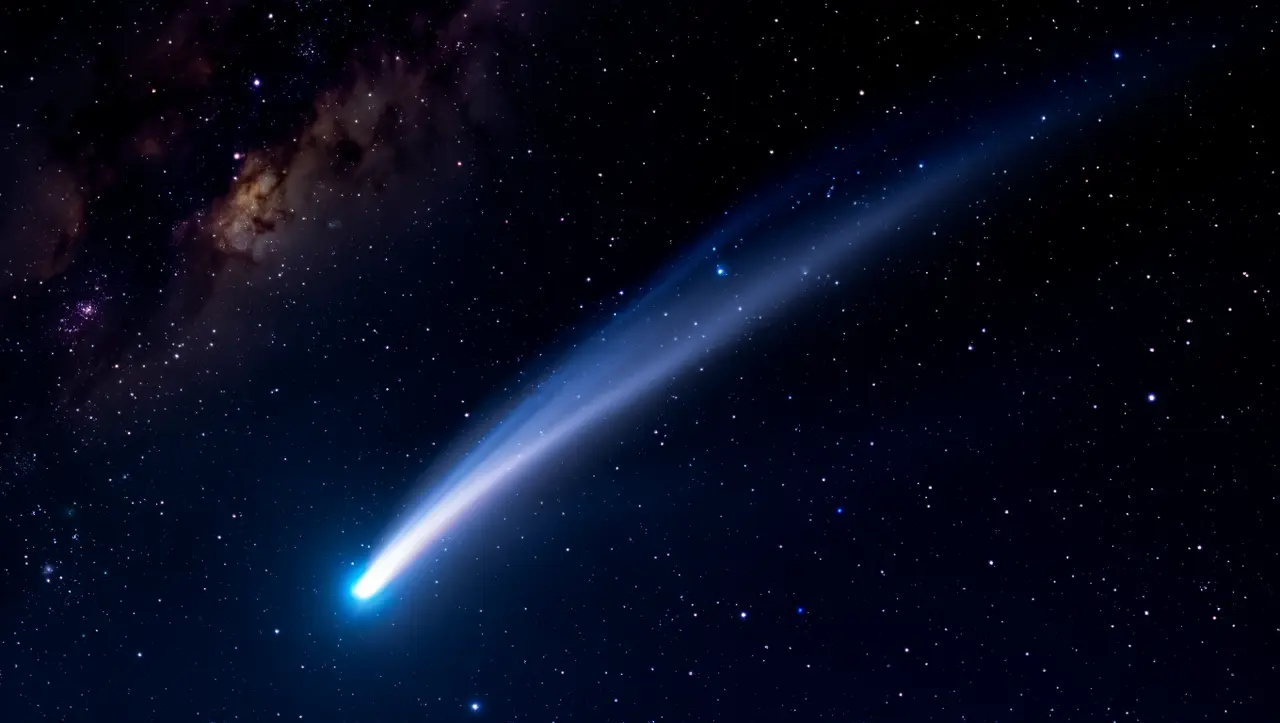
Only in the main “reservoirs” — the Kuiper Belt and the Oort Cloud — are hidden billions, perhaps trillions, of comets. Most of them will remain eternal wanderers in the cosmic backyard. But the gravity of passing stars or giant planets sometimes kicks them into the inner Solar System. That’s when we get to observe these icy boulders with fiery tails.
Simply put, a comet is a fluffy clump of silicate dust and organics, covered with a multilayered “coat” of water ice. Some of these icy dust grains are our inheritance from the giant molecular cloud that collapsed to give birth to the Solar System. But much of it formed later inside the solar nebula itself.
The birth of a comet resembles a game of snowballs, stretched over thousands of years and vast cosmic distances. It all starts far from the center of the nebula, about 100 astronomical units from the Sun (for comparison: Earth is just 1 such unit away). There, icy dust grains begin to stick together into fluffy, cotton-like clumps. At first, their motion is entirely governed by gas flows. But when a clump grows to the size of a boulder, gravity and gas friction start to slow it down. Comets begin to drift inward toward the Sun, continuing to accrete new material along the way. This is how a nucleus 10–20 km in diameter grows in about 100,000 years.
However, this simple picture long troubled scientists. The composition of comets turned out to be too complex for such a straightforward journey. They found crystalline olivine — a mineral never seen in cold interstellar clouds. For amorphous dust to turn into crystals, it had to be heated to nearly 1000 °C. But how do you combine a red-hot furnace with an icy boulder? It’s like trying to bake a cupcake inside a snowball.
Experiments confirmed: if the temperature rises above 850 °C, the comet’s icy coat would simply evaporate. Therefore, the “hot” crystals and the “cold” ice were born in different places and met later. The solar nebula turned out to be much more complex than previously thought: powerful mixing mechanisms were at work, transporting material from the hell of the inner cosmos to the cold backyards where comets grew.
Today, scientists increasingly believe that powerful winds blowing from the young Sun are responsible. These winds could have ejected heat-processed materials outward. That means each comet is not just a snowball but a medley of ancient substances collected from different corners of the primordial cloud.
- A powerful solar flare disrupted communications in Asia and Australia
- Solar flares: how they affect our lives
- What would happen if the Sun exploded
How comets die
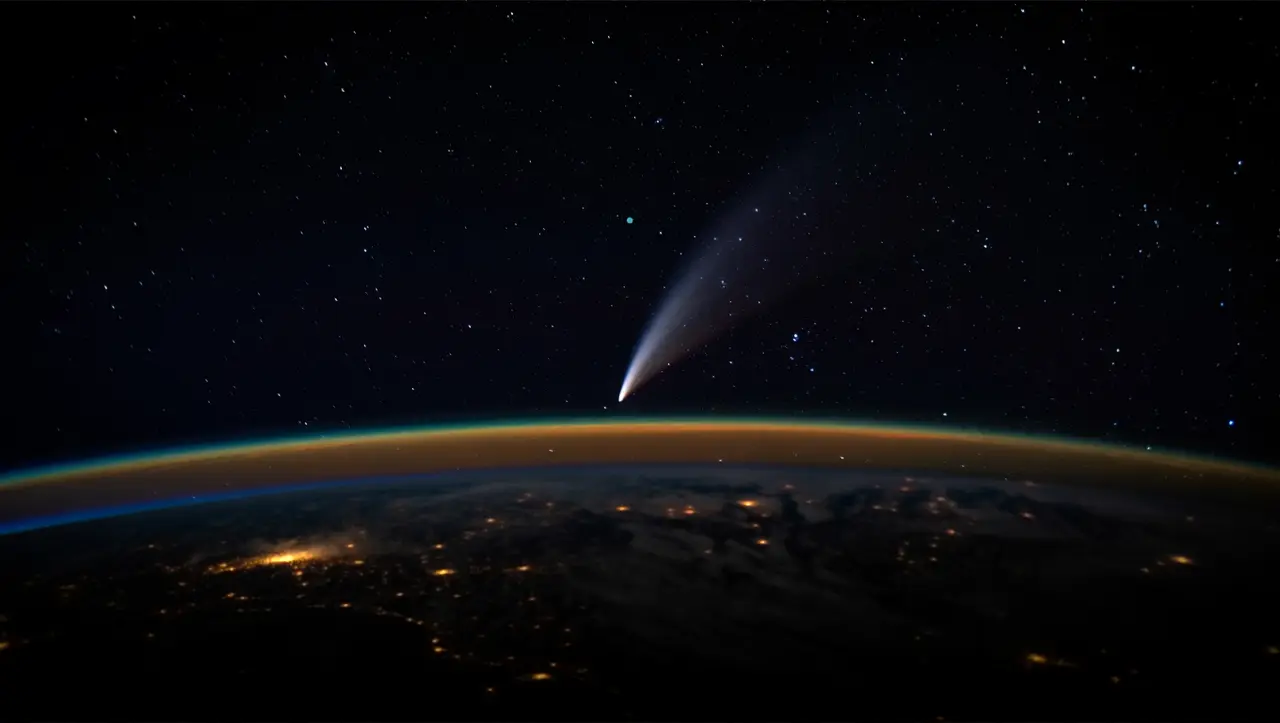
After birth, comets embark on a long journey. Most of them spend billions of years far from the Sun, in the icy darkness of the Kuiper Belt or the Oort Cloud. They remain there until a random gravitational nudge sends them falling toward the center of the system. Only when a comet approaches the Sun does the ice begin to evaporate, and it develops the very tail we see from Earth. This journey to the star can take a comet from several tens to millions of years — depending on where it came from.
But nothing lasts forever. Even comets reach a moment when their story ends. On average, comets live about 10,000 years after their first pass by the Sun. Guests arriving from the Oort Cloud are slightly “luckier,” but their end is inevitable.
Many comets do not die in the literal sense but permanently leave their home. Passing near Jupiter or other giant planets, they can receive a gravitational “kick” that gives them enough speed to exit into interstellar space.
Others die spectacularly — by crashing into planets or the Sun. For example, in July 1994, when comet Shoemaker‑Levy 9 crashed into Jupiter. Earth has also suffered such impacts many times, and humanity carefully watches the sky not to miss any potential threat.
But the most common ending is gradual fading. Every time it approaches the Sun, a comet loses part of its substance. Ices evaporate, taking dust with them. At some point, so much material is lost that the nucleus simply ceases to exist, crumbling into a swarm of dust that we sometimes observe as a meteor shower. A classic example is comet Biela, which broke apart in the 19th century.
But there is also a quieter, almost imperceptible end. Dust-rich comets may eventually become covered with a crust of dark matter. Some of the dust ejected by the nucleus does not disappear forever but settles back, sealing the ice beneath a thick layer of soot. The comet “turns off,” becoming an inert rock indistinguishable from a regular asteroid. Such objects are called “extinct comets.” They still circle along their orbits, but the activity inside them has died out forever.