How they differ from solar storms and whether they truly affect human health.
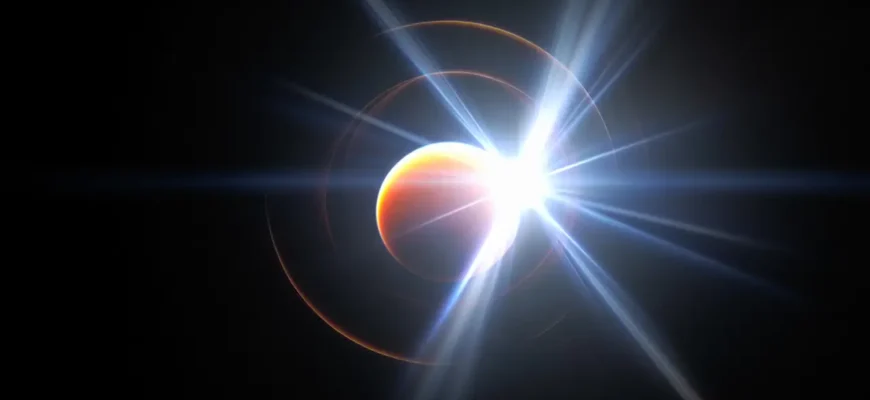
It seems that the Sun is a star that rises and sets each day without surprises. But in reality, its surface is a turbulent ocean of superheated plasma, where colossal energy releases occur regularly, capable of reaching our planet.
What Are Solar Flares
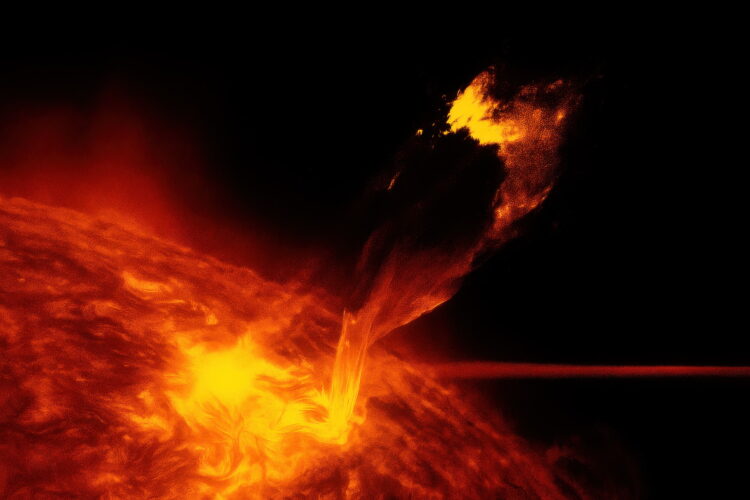
To imagine their power, it’s enough to recall a historical example. The most powerful “solar superstorm” was the so-called Carrington Event, which occurred in 1859. The solar flare was so strong that it led to a massive coronal mass ejection, which reached Earth in just 18 hours and triggered a geomagnetic storm.
Nearly all inhabitants of the planet felt the consequences. Telegraph systems across Europe and North America failed—some devices operated and sparked even while disconnected from power. Aurora borealis was observed worldwide, even over the Caribbean. Above the Rocky Mountains in North America, the glow was so bright that it woke gold prospectors—they began preparing breakfast, thinking morning had already arrived.
Why Solar Flares Occur
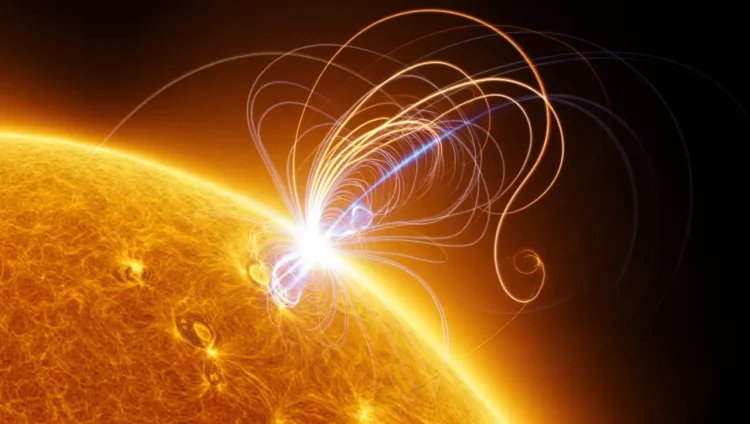
The occurrence of solar flares is directly related to the dynamics of the Sun’s magnetic fields. Our star, unlike Earth, is a rotating sphere of superheated plasma, where different layers move at different speeds. This creates a complex pattern of magnetic fields that constantly twist and build up tension.
Sunspots—regions with particularly intense magnetic fields—play a special role in this process. When tension in the magnetic fields reaches a critical point, their sudden reconfiguration occurs, accompanied by colossal energy release. This process can be compared to the sharp snapping of a tightly twisted rubber band, when all accumulated energy is released instantly.
Types of Solar Flares
- Class A — weak flares that typically do not significantly affect Earth;
- Class B — moderate flares that may cause some radio communication interference at the poles;
- Class C — medium flares that may cause brief radio interference in the lower atmospheric layers;
- Class M — strong flares that may cause moderate geomagnetic storms as well as major radio interference;
- Class X — extremely powerful flares that can provoke serious disruptions in power grids and satellite communications across the entire planet, causing severe geomagnetic storms.
How Solar Flares Are Related to Solar Storms
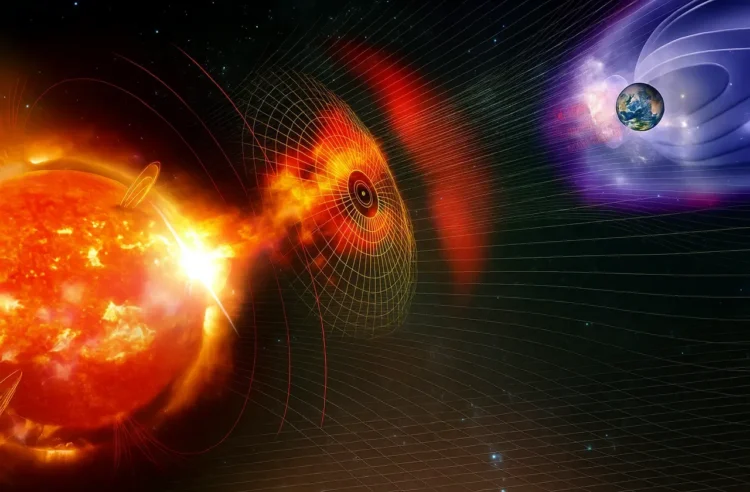
There is a clear cause-and-effect relationship between solar flares, solar storms, and magnetic storms. These three phenomena are different stages of one cosmic process.
A solar flare is an instantaneous powerful release of electromagnetic radiation that reaches Earth in approximately eight minutes.
A solar storm, or coronal mass ejection, is the ejection of a giant cloud of plasma and magnetic field. It moves much more slowly, at a speed of about 1,000 km/s, and reaches our planet within a period of one to three days.
A magnetic storm occurs when the plasma cloud collides with Earth’s magnetic field. The collision causes powerful disturbances in the magnetosphere that can last several days. Magnetic storms are responsible for the most spectacular consequences—from auroras to power grid failures.
Thus, a flare is a quick signal, a solar storm is a “projectile” flying toward Earth, and a magnetic storm is an “explosion” on our magnetic shield. Therefore, a powerful flare is an important warning signal that allows scientists to predict a possible magnetic storm with high probability.
Separately, there is the solar wind—a constant, weaker stream of plasma particles. This is the “background breathing” of the Sun, which never stops.
How Solar Flares Affect Humans

First and foremost, solar activity affects technological infrastructure. Power systems can experience overloads, leading to massive power outages. Satellites are particularly vulnerable—charged particles can damage their electronic components and solar panels. Serious failures occur in communication and navigation systems, where ionospheric disturbances disrupt the normal propagation of radio waves.
Charged particles from flares can reach near-Earth space, creating a radiation hazard for astronauts in open space (by the way, have you ever wondered how their day in orbit is organized?) and passengers on aircraft at high altitudes.
According to a scientist from the European Medical Center, evidence-based medicine long denied the impact of magnetic storms on well-being and objective health indicators. However, recent studies have refuted these findings. In 2025, a major study published in the journal Nature proved the impact of solar flares on blood pressure, with this effect being more pronounced in women.
“There are also studies that have identified a correlation between solar activity and migraine attacks, cardiac arrhythmia episodes, and some other cardiovascular diseases. At the same time, a large meta-analysis that examined mortality statistics in several European hospitals found no connection with magnetic storms.”
For most people, the main “symptoms” remain technological failures. A pleasant bonus is that during periods of solar activity, we have the opportunity to witness spectacular auroras, which can sometimes be seen even at unusual latitudes.