Riga — detailed city guide with photos. Top landmarks of Riga with descriptions, travel guides, and maps.
City of Riga (Latvia)
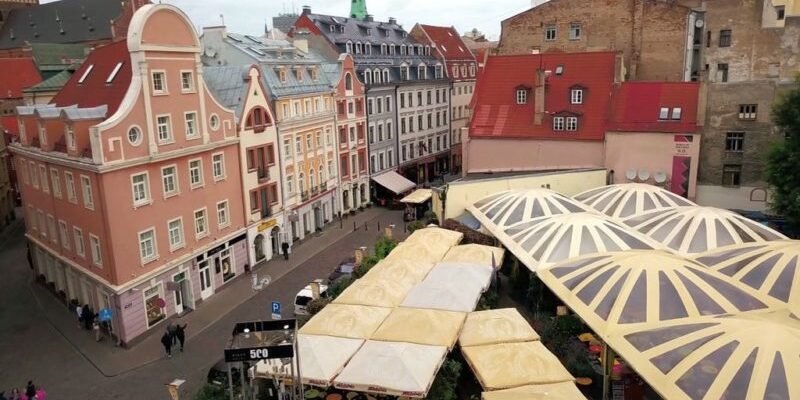
Riga (Latvian: Rīga) is the capital of Latvia and the largest city in the Baltic states, located on the Baltic Sea coast at the mouth of the Daugava River, which flows into the Gulf of Riga. Riga is famous for its landmarks and Old Town, a UNESCO World Heritage Site. The historic center is a stunning mix of diverse architecture, ranging from medieval to Art Nouveau (Jugendstil). The facades of many buildings are adorned with intricate carvings, mythological and historical motifs, inscriptions, and other decorative elements.
The Daugava River divides Riga into two parts. The Old Town is situated on the eastern bank. Much of the city was destroyed by fires or damaged during World War II. As a result, most buildings have either been carefully restored or completely rebuilt in the 1990s to revive Riga’s historic charm and enhance its tourist appeal. The Old Town is surrounded by 19th- and 20th-century architecture, followed by Soviet-era high-rise buildings.
Geography and Climate
Riga is located on the shores of the Gulf of Riga in the Baltic Sea, along the Daugava River. The northern and eastern sides are the most populated, while the western area consists of marshland. The outskirts of Riga are dotted with small lakes and streams.

The climate is moderately continental, featuring warm, rainy summers and relatively mild, snowy winters. Average summer temperatures range between 15-20°C (59-68°F). Winters typically see light frosts with frequent thaws.
History and Interesting Facts
Riga was founded in 1201 by Bishop Albert of Bremen, who built a small stone church here. However, as early as the mid-12th century, Swedish traders had already been visiting the mouth of the Western Dvina River, from which the city derived its name. In its early years, the new settlement developed rapidly. Riga soon became the center of the historical region of Livonia. By the second half of the 13th century, the city joined the Hanseatic League, transforming into the most important trade hub in the Baltics. Riga remained part of the Hanseatic League until the 15th century.
With the expansion of the Teutonic Order eastward in 1492, the archbishop recognized its protectorate. In 1522, the Reformation ended the rule of Riga’s archbishops. After the Livonian War, Riga became a free imperial city.

In the first half of the 17th century, the city became part of the Swedish Kingdom with broad autonomous rights. After the Great Northern War, Riga was incorporated into the Russian Empire. The city’s development continued until World War I. In 1918, it was occupied by German forces, and Latvia declared independence. In 1940, Latvia became part of the Soviet Union and remained a socialist republic until 1991. In May 2004, the country joined the European Union.
How to Get There
Riga is connected by air to most major European cities. The international airport is located about ten kilometers southwest of the city. Bus 22 runs from the central bus station to the airport every 10-15 minutes. Ferry connections are available to Stockholm, Copenhagen, and Kiel.
You can also reach Riga by train from Kyiv. Buses are another convenient option, with routes operating from Kyiv, Lviv, Warsaw, St. Petersburg, and other cities. Major highways connect Riga to Tallinn, St. Petersburg, Vilnius, and Minsk.

Cuisine and Nightlife
Riga’s gastronomy—and Latvian cuisine in general—is a blend of traditional, European, and Russian influences. Local restaurants emphasize fresh seasonal vegetables and fruits. Traditional Latvian dishes include potatoes, cabbage, turnips, beef, pork, game, fish, and foraged ingredients. The Latvian capital is also known for its affordable prices, making it easy to find great food at reasonable prices.
To find cafes or restaurants, visit this website: www.liveriga.com
Riga is also famous for its vibrant nightlife. The Old Town is packed with clubs and bars that cater to partygoers.

Secret Riga guide: 10 cool places tourists don’t know about
Shopping
Riga is one of the top shopping destinations in the Baltics. The historic streets are lined with shops selling amber, wooden crafts, ceramics, traditional foods, shoes, and clothing. For cheaper souvenirs, visit the Central Market near the train station or explore the Old Town’s side streets.
Major Shopping Centers:
- GalleriaRiga – over 85 stores.
- Podium – a shopping center in the historic district with many brand-name stores.
- ELKORPLAZA – a wide selection of clothing, shoes, souvenirs, toys, and groceries.
- Galerija Centrs at Audēju 16 – 120 stores, restaurants, and cafes.

In December, Christmas markets open in the Old Town, transforming Riga into a fairytale-like winter wonderland.

Getting Around
Public transport in Riga includes trams, buses, and trolleybuses, all using an electronic ticketing system. Tickets are available for single rides, 24-hour passes, or multi-day options. Tickets can be purchased at kiosks, vending machines, or newsstands. Riga has 11 tram lines, 55 bus routes, and 27 trolleybus lines. Trams are the fastest and most convenient way to travel around the city.

Landmarks and Attractions
Riga is a city of fascinating landmarks, where centuries of history meet modernity through unique architecture, ancient streets, and charming squares. The historic center is a UNESCO World Heritage Site.
Top Attractions in Riga
The heart of Old Riga is Town Hall Square, one of the oldest squares in the city. It was nearly destroyed during World War II and has since been meticulously restored.
The architectural highlight of the square is the House of the Blackheads and the Town Hall. The House of the Blackheads, built in the early 14th century, is one of Riga’s oldest buildings. Originally used for city functions, it became a merchants’ guild headquarters in the 17th century. The building was almost completely destroyed in 1941 and was only restored a few decades ago.
Opposite the House of the Blackheads stands the reconstructed Town Hall, now home to Riga’s municipal government.

At the center of Town Hall Square stands the statue of Roland, a symbol of justice and freedom. The original statue was erected over 100 years ago but was destroyed in World War II. The current replica was restored in recent years. Similar statues can be found in other European cities, with the most famous being the Bremen Roland.
Near Town Hall Square, the towering spire of St. Peter’s Church pierces the sky. A masterpiece of Gothic architecture, it is the tallest religious building in Riga. Constructed in the 13th century, it remains one of the most significant sacred landmarks in the Baltics. Inside, visitors can explore the church’s history and view ancient tombstones.
The next must-visit site is Dome Square, the largest square in Old Riga. It was created in the 19th century after the demolition of older buildings.

The architectural crown jewel is Riga Cathedral (Dome Cathedral), the city’s main church and one of the largest and oldest religious buildings in the Baltics. Its foundation dates back to the 13th century. This majestic structure combines Romanesque, Gothic, and Baroque styles. It was founded by Albert of Bremen—Riga’s founder—and acquired its current appearance in the 19th century.
The Jacob’s Barracks—an 18th-century complex—stands at the edge of the Old Town. Opposite it are the Powder Tower and the Swedish Gate.
The Swedish Gate is the only surviving city gate of the original eight, built in the late 17th century.

The Powder Tower, mentioned since the 14th century, was used to store gunpowder in the 17th century.
Another must-see is Livu Square, a hub of youth activity, and Albert Square.
At Livu Square, don’t miss the famous Cat House—a century-old building with copper cats on its roof, facing the Great Guild. Legend has it that a wealthy merchant, denied entry into the guild, built this house with cats turning their backsides toward the guild in defiance.
The Great Guild building, constructed in the mid-19th century, is also worth a look.
Riga Castle—nearly as old as the city itself—has stood on the banks of the Daugava for almost seven centuries. The first castle on this site dates back to the early 14th century. Over the centuries, it has been destroyed and rebuilt multiple times. Originally a defensive fortress, its round towers were added in the 15th century. Today, it serves as the Latvian president’s residence and is a prime example of classicism. Like any ancient castle, it is steeped in legends.
Other Landmarks and Points of Interest
The building at Strēlnieku iela 4a, built in the early 20th century, is a masterpiece of Art Nouveau. Albert Street is another must-visit, lined with stunning Art Nouveau buildings.
At Mazā pils iela 17, you’ll find the “Three Brothers,” the oldest residential complex in Riga, dating back to the 15th century.

Riga Radio and TV Tower—the tallest structure in the Baltics and one of the tallest in Europe—was built during the Soviet era between 1979 and 1986. Standing at 368.5 meters, it is visible from almost anywhere in the city.
Near St. Peter’s Church is the “Town Musicians of Bremen” sculpture, inspired by the Brothers Grimm fairy tale but with a political twist.

Nativity of Christ Cathedral—Riga’s largest Orthodox church—was built in the late 19th century in the Neo-Byzantine style.
St. James’s Church—a 13th-century Lutheran church with an elegant Gothic tower—is now a Catholic church.
St. John’s Church is considered the oldest religious building in Riga, taking its current form in the early 16th century.
St. Gertrude’s Church is a 19th-century Neo-Gothic Lutheran church.
In the mid-19th century, an Anglican church was built on the site of an old bastion.
Another hidden gem is the Convent Yard—a complex of medieval Hanseatic-era buildings that took their current form in the 17th century.
Video – City of Riga