From the Town Musicians statue to Gothic cathedrals, Bremen blends history and whimsy. Plan your trip with our guide to top attractions, food, and culture.
Bremen, Germany: A Complete Guide to the Hanseatic City
Bremen (German: Bremen) is a city in northwestern Germany, located on the Weser River, about 60 km from the North Sea coast. It gained worldwide fame thanks to the Brothers Grimm fairy tale “The Town Musicians of Bremen.” Bremen is one of the proud Hanseatic cities with a unique charm, numerous fascinating landmarks, beautiful historic architecture, and a rich history. The city is one of the main cultural and tourist centers of northwestern Germany.
Bremen is a place where history comes alive. Visitors can admire medieval architecture with winding streets and centuries-old houses of wealthy merchants and nobles, Gothic churches, and the enchanting atmosphere of the old harbor.

Despite being located over 50 km from the sea, Bremen is an ancient port city. Together with Bremerhaven, it forms the federal state of the Free Hanseatic City of Bremen and is one of Germany’s largest universal ports. The city blends old and modern architecture, with new districts standing alongside charming medieval streets. Additionally, Bremen is one of the greenest cities in Germany, with green spaces covering around 2,800 hectares.
Practical Information:
- City area – 325 sq. km.
- Population — over 500,000
- Average annual temperature – 9.3°C.
- Annual tourist visits — over 4 million.
History
Bremen is a city with a thousand-year history. The first written records date back to the 8th century.
Key milestones in Bremen’s history:
- 780 AD — Charlemagne sends Anglo-Saxon missionaries to northern Germany.
- 782 AD — first mention of the city.
- 1035 AD — Emperor Conrad II grants the right to hold spring and autumn markets, a tradition that persisted throughout the city’s history.
- 1303 AD — Bremen receives city rights.
- 1350 AD — one-third of the population dies from the plague.
- 1358 AD — joins the Hanseatic League.
- 1404 AD — construction of the Gothic town hall begins; a 10-meter stone statue of Roland, symbolizing Bremen’s independence, replaces the old wooden one.

- 1580 AD — construction of a new port.
- 1600 AD — the beginning of economic and cultural prosperity.
- 1646 AD — Bremen becomes a free imperial city.
- 1806 AD — the German emperor grants the title “Free Hanseatic City.”
- 1827 AD — founding of Bremerhaven.
- 1847 AD — construction of the Bremen-Hanover railway.
A virtual historical model of Bremen is available at: http://www.historisches-bremen.de/

Climate
The climate is temperate, with a strong maritime influence due to the proximity of the North Sea. Summers are warm, and winters are relatively mild. However, continental air masses can sometimes bring tropical heat in summer and severe frost in winter.
The warmest month is July, and the coldest is January. Precipitation is evenly distributed throughout the year, with slightly more in summer. Snow cover typically lasts no more than 20 days per year.
How to Get There
Bremen is well-connected by transport infrastructure. The city can be reached by plane. The airport is located 3.5 km from the city center. Tram line 6, running every 10 minutes, will quickly take you to the city center (Domsheide stop).

You can also arrive by train. Bremen is connected by rail to many major German cities, including Hamburg, Hanover, Berlin, and others. The railway station is located in the city center and is one of the most modern in Germany.
Intercity buses are another affordable option for reaching Bremen. Numerous companies offer direct routes without transfers. We recommend FlixBus for bus travel.

Public Transport
Public transport includes buses and trams. Bicycles are also very popular. Bremen’s public transport serves around 250,000 passengers daily.
Shopping
Historically, Bremen grew as a merchant city, so shopping opportunities abound. The city center is filled with souvenir shops, clothing stores, and food markets.
If that’s not enough, Bremen has several shopping centers:
Domshof
- Tram: 4, 6, 8
- Bus: 24, 25
- Stop: Schüsselkorb
Kaufhof Gallery
- Tram: 2, 3
- Stop: Obernstraße
Weserpark — Bremen’s largest shopping mall with over 170 stores.
- Tram: 1
- Stop: Weserpark
- Bus: 37
- Stop: Am Großen Kuhkamp
- Bus: 38, 39
- Stop: Weserpark Süd
- Weser Ems Bus: 740
- Stop: Weserpark
Karstadt Sports — the largest selection of sports goods in Bremen.
- Tram: 2, 3
- Stop: Obernstraße
Gastronomy
Bremen’s cuisine combines North German provincial dishes, Saxon influences, and coastal traditions. The food is typically hearty.
Traditional dishes:
- Kohl / Pinkel
- Hochzeitssuppe
- Bremer Labskaus
- Bremer Kluten
- Knipp
- Schellfisch
- Bremer Kükenragout
We highly recommend trying Bremen’s sweets, chocolates, and coffee. For alcoholic beverages, don’t miss the local beer.
Maritime Bremen
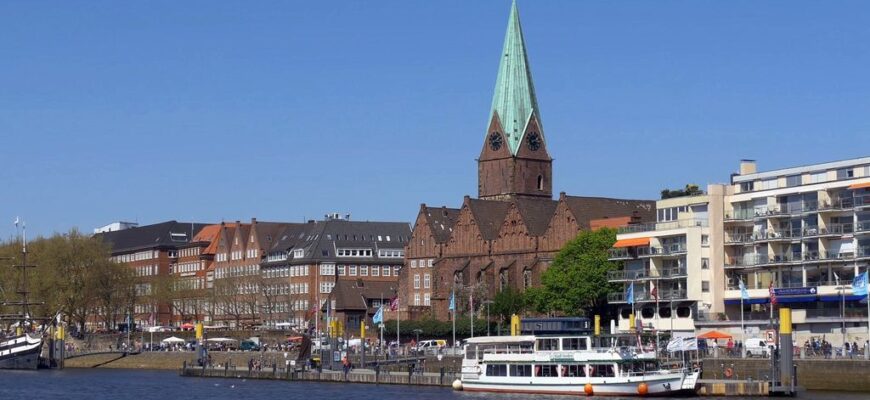
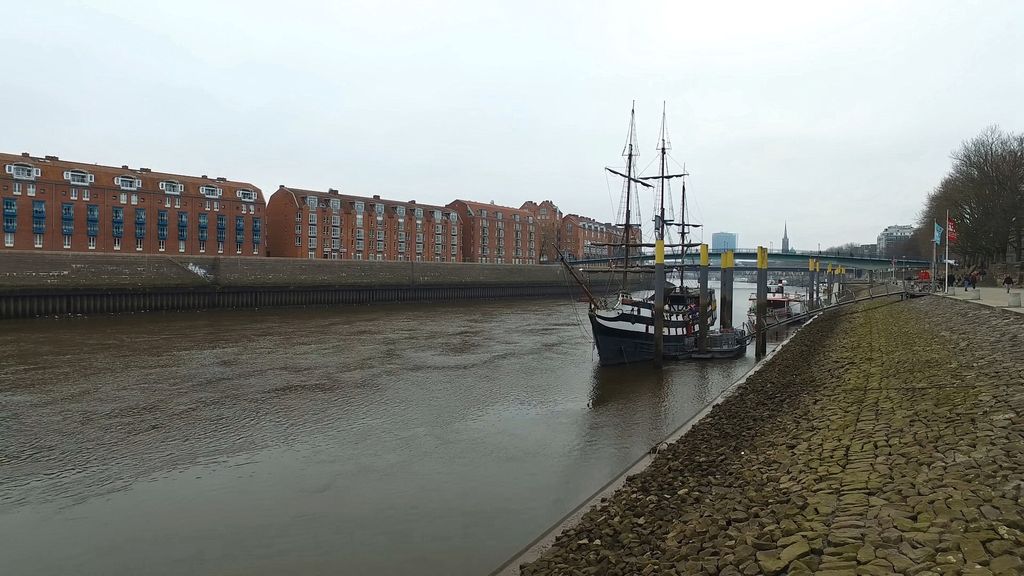
Bremen’s history and development have always been tied to the sea and trade. Maritime traditions are strong here, with famous sailing ships and vessels along the river, adding to the romantic seafaring atmosphere. Numerous ferries offer short trips on the Weser River. Visitors can also explore maritime-themed museums like Focke, Übersee, and Hafenmuseum.
One of the most fascinating river attractions is the “Ship with Green Sails,” which carried the famous explorer Alexander von Humboldt on his voyages. This ship crossed the Atlantic Ocean and Cape Horn multiple times.
Theaters
Bremen is the cultural capital of northern Germany. Visitors can enjoy:
- Opera House
- Musical Theater
- Variety Theater
- Puppet Theater
- Detective Theater
- Several smaller theaters and concert halls.
Landmarks of Bremen
Bremen is a city with a unique charm: historic architecture, winding streets, and remarkable cultural and historical monuments. It is one of Germany’s most interesting and beautiful cities. Here are the most popular landmarks.
Market Square

Market Square (Marktplatz) is the heart of the Old Town and one of Bremen’s oldest and most important squares. Its architectural ensemble is among the most beautiful in Germany. Five streets lead to the square, and two smaller squares adjoin it: Unser-Lieben-Frauen-Kirchhof, Am Dom, Marktstraße, Dieter-Klink-Platz, Langenstraße, Wachtstraße, Schüttingstraße, and Obernstraße.
The square has a slightly irregular trapezoidal shape. The northeastern side is 60 meters long, the southeastern side is 54 meters, the northwestern side is about 51 meters, and the southwestern side is 74 meters.

The northeastern side features Bremen’s Town Hall, while the southeastern side includes the Grasmarkt, the cathedral, and the stock exchange building. The southwestern side has historic merchant and banker houses, and the northwestern side features 16th-17th-century buildings.
The Town Musicians of Bremen

The Town Musicians of Bremen is a bronze statue from the 1950s, symbolizing one of Bremen’s most famous icons. The legendary quartet of traveling musicians, known worldwide from the Brothers Grimm fairy tale, has made Bremen famous. The statue stands near the western wall of the town hall.
Bremen Roland

The Bremen Roland is a symbol of the city’s rights and freedoms, the largest and oldest statue of its kind in Germany, and a UNESCO World Heritage Site. This “statue of liberty” was built in 1404 from stone, replacing an older wooden version. Over 6 meters tall, Roland is a mighty knight with a sword and shield, dressed in early 15th-century attire.
Town Hall

The Town Hall is one of the main landmarks in the historic center. This beautiful early 15th-century building is a UNESCO World Heritage Site and a masterpiece of Hanseatic architecture. It served as the city’s main administrative building for centuries.
St. Peter’s Cathedral

St. Peter’s Cathedral is the oldest religious building in Bremen, with a 1,200-year history. This Evangelical Lutheran church in Gothic style, with two tall towers, dominates the city’s main square. The cathedral’s crypt houses ancient relics.
Schnoor Quarter

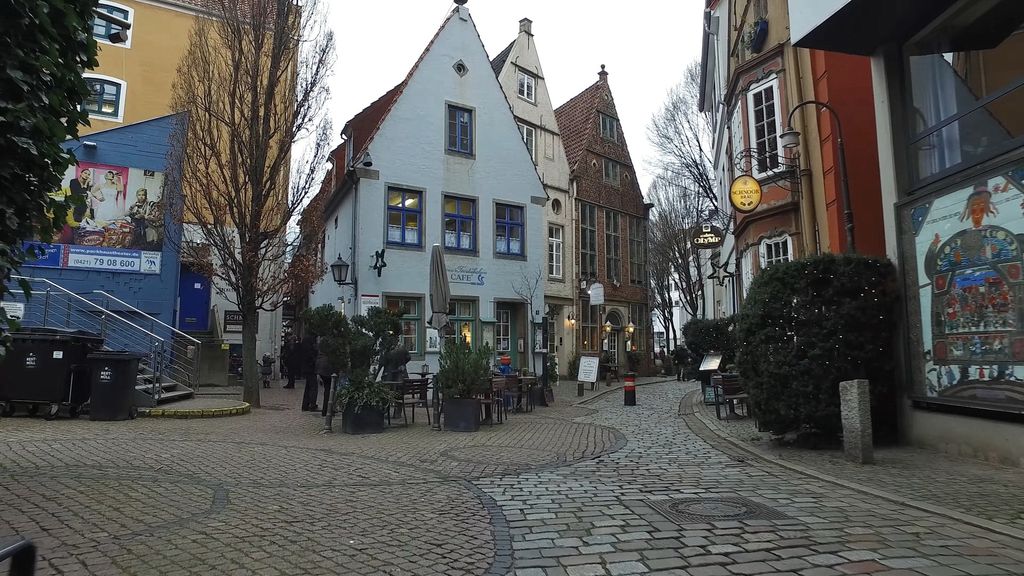
The Schnoor Quarter is one of Bremen’s oldest districts, with a charming medieval atmosphere. Its 15th-16th-century half-timbered houses and narrow cobblestone streets transport visitors back in time. The area also has many souvenir shops and cozy restaurants.
Other Landmarks
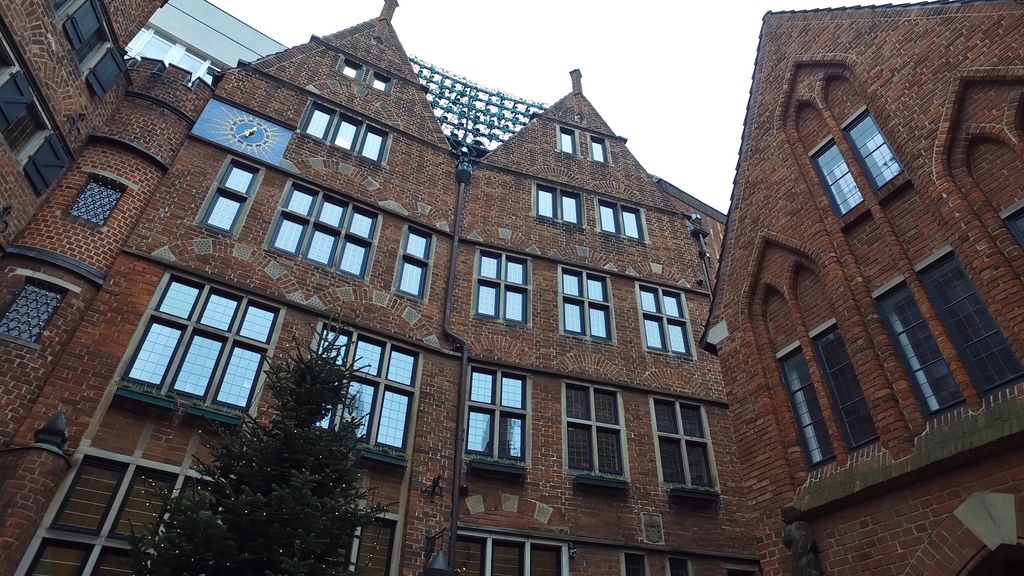
Böttcherstraße — A street with unique architecture, shops, museums, and workshops. The surrounding buildings were constructed in the 1920s, replacing older structures. Don’t miss the Handwerkerhof fountain and the “Seven Lazy Ones” sculptures embedded in a nearby facade.
The Glockenspiel (“Carillon”) features 30 small bells that enliven the street’s atmosphere. A neighboring tower displays 10 shields honoring adventurers who crossed the ocean.
The “Upside-Down Chest of Drawers” — A 19th-century water tower now hosting exhibitions. Reachable by trams 4, 6, or 8 (Wilhelm-Kaisen-Brücke stop).

The Church of Our Lady — A Gothic church with a 1,000-year history, located in the historic center near the Weser River.
The Weigh House — A late 16th-century building with a Renaissance facade, once used for city weigh-ins. Severely damaged in 1944, it was carefully restored in 1959.

St. Martin’s Church — A 13th-century brick Gothic church near the Market Square.
The Sielwall district is Bremen’s nightlife hub, featuring upscale restaurants, authentic pubs, street art, and clubs.
St. John’s Church — The main Catholic church in Bremen, a 14th-century brick Gothic basilica near Marktplatz.
Behind the cathedral, on Domsheide street, stand the courthouse and police station, built in traditional German brick style.
The “Wool House” on Herdentor street is one of Bremen’s most striking commercial buildings, constructed in the 1930s with an Art Deco marble lobby.
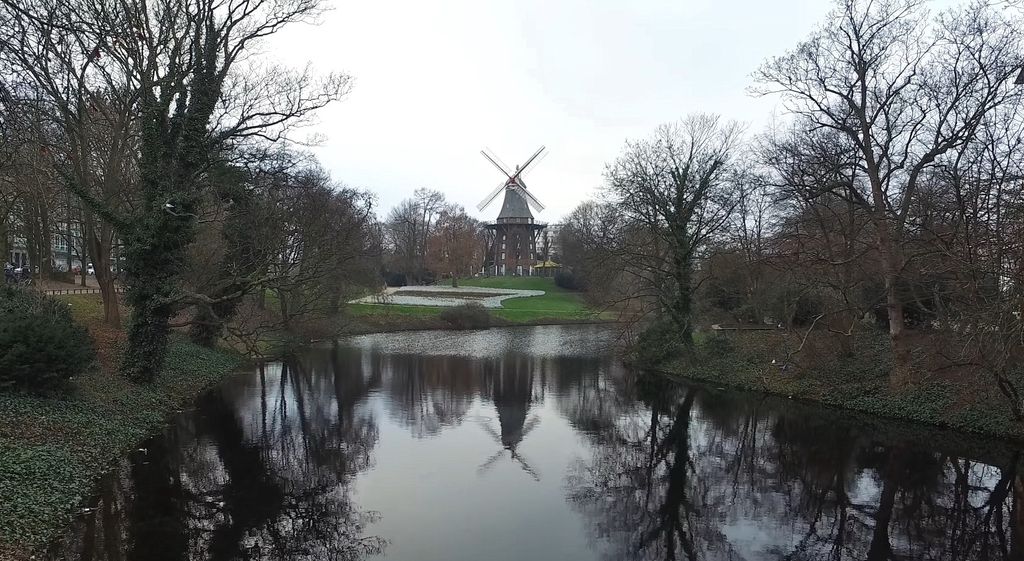
A windmill stands in a small park on Am Wall street, built a century ago.
For science enthusiasts, the “Falling Tower” on Klagenfurter Straße is worth a visit. This 146-meter tower hosts zero-gravity experiments.
Video — City of Bremen