Graz (Austria) — detailed information about the city with photos. Main sights of Graz with descriptions, guides, and maps
City of Graz (Austria)
Graz (German: Graz) is a city in southeastern Austria, the capital of the federal state of Styria. It is the second most populous city in the country after Vienna. Graz boasts one of the best-preserved historic centers in Europe, which is listed as a UNESCO World Heritage Site. It is filled with grandiose Baroque buildings and interesting landmarks. The large Schlossberg hill towers over the picturesque old town. Many of the preserved historic buildings were constructed under the influence of Italian architectural styles. Graz itself is an important cultural, educational, and scientific center of Europe.
Geography and Climate
Graz is situated on the Mur River, 200 km southwest of Vienna, close to the border with Slovenia and 50 km from Slovenian Maribor. The climate is temperate. Due to its position southeast of the Alps, Graz is protected from cold western and northern winds. It is much warmer here than in other parts of Austria, with significantly more sunny days.

Practical Information
-
Population — over 300,000 people.
-
Area — 127.56 square kilometers.
-
Language — German.
-
Currency — Euro.
-
Visa — Schengen.
-
Time — Central European UTC + 1, in summer + 2.
-
Tourist Information Center is located on Herrengasse, 16.
History and Interesting Facts
Graz’s roots go back to a Roman past. The Romans built a small fort on the site where the old town is now located. In the Middle Ages, Slovenes erected a larger fortress. The name “Graz” derives from the Slovene word “gradec,” meaning “small castle.”

Graz was first mentioned in 1128 when the Babenberg dukes transformed the location into a major trading center. In the 15th century, under the Habsburgs, the city became the capital of Inner Austria. In the 16th century, Graz was repeatedly attacked by the Turks, however, the fortress located on the Schlossberg hill was never captured. During the Second World War, the city was liberated by Soviet troops and practically did not suffer from bombing.

How to Get There
Graz Airport is located 9 km south of the city center. From here, there are regular flights to Amsterdam, Frankfurt, Istanbul, Munich, Stuttgart, and Zurich. From the airport to the center, you can take buses No. 630, 631 and the S5 train.
The main railway station (Hauptbahnhof) is situated on the western outskirts of the historic center. Direct trains arrive in Graz from Vienna, Salzburg, Zurich, Zagreb, Budapest. The A9 and A2 motorways pass near the city.
Graz Hotels on the Map
Shopping and Purchases
Don’t forget to buy a bottle of Kernöl (pumpkin seed oil). This oil is typical for Styria and has a unique, pleasant taste. It can be found on the squares Kaiser-Josef-Platz and Lendplatz. The main shopping street of Graz is Herrengasse. Many shops are also located on Mariahilferstraße, Schmiedgasse, and Sporgasse streets. The City Park shopping center is on the southwestern outskirts of the center. Among the large shopping centers outside the historical core are Shopping City Seiersberg (bus No. 78) and Murpark (tram No. 4).

Food and Drinks
Styrian cuisine is a blend of Austrian culinary traditions with Mediterranean influences. Typical local dishes: pumpkin cream soup, Styrian chicken breast with corn, yogurt with herb sauce, anise cookies, Styrian-style breaded chicken with herbs, nut roll, smoked trout in tartar sauce, pumpkin seed Kipferl, trout with Riesling wine, fried apple rings, beef fillet with mashed potatoes and celery, pumpkin cream with vegetables, beef steak with beans.

Sights and Landmarks
Old Town (Altstadt) of Graz is a UNESCO World Heritage Site. It contains many medieval houses and buildings in the Italian Renaissance style, hidden courtyards, and narrow streets. The main square of the city — Hauptplatz — is located on the left bank of the Mur River. It features a statue of Archduke Johann.

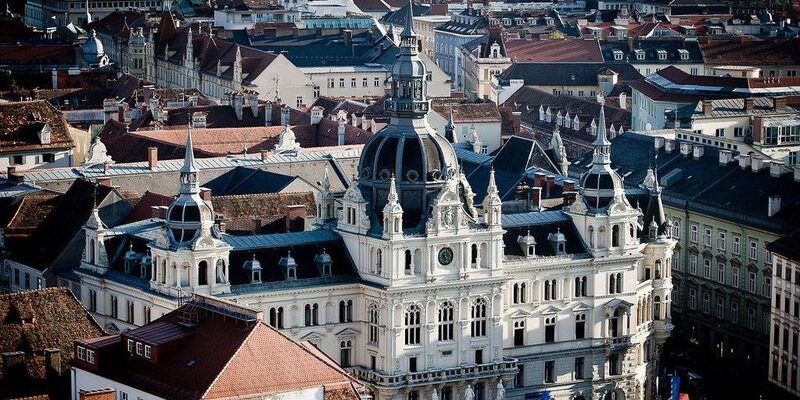
Right here, on Hauptplatz, is the Town Hall, built at the end of the 19th century, and the historic Luegg House (17th century) with an attractive arcaded facade and stucco decoration.

To the west of the main square is the Gothic Franciscan Church (Franziskanerkirche), known for its high 17th-century western tower and late Gothic nave with ribbed vaulting. Be sure to take a walk along Herrengasse street with its numerous beautiful old houses, including the wonderful “Painted House” (Gemaltes Haus), decorated with 18th-century frescoes.
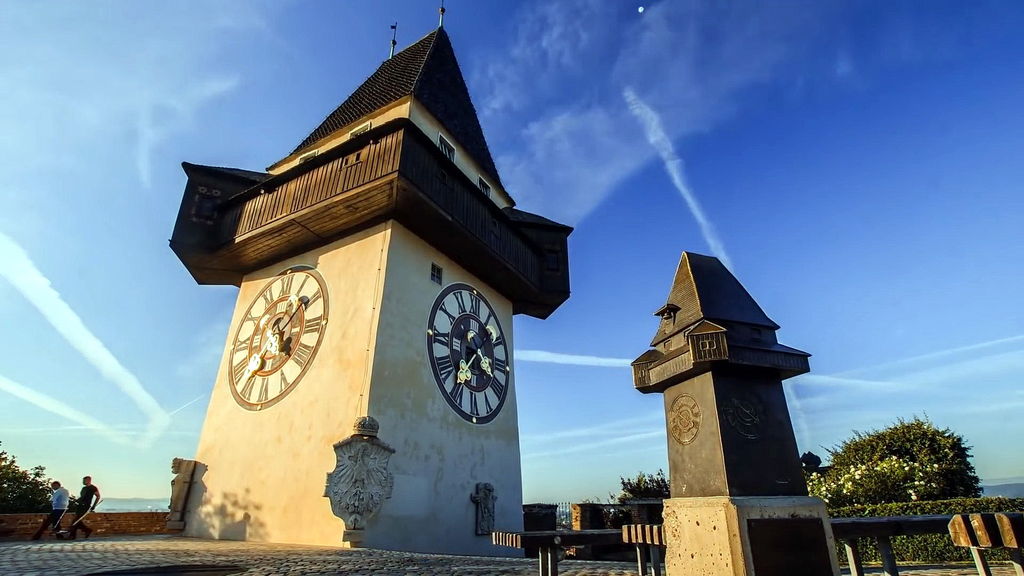
Castle Hill (Schlossberg) — one of the most popular sights of Graz, offering a stunning view of the old town. The massive medieval fortifications were mostly dismantled after the Treaty of Vienna in 1809. Only the ancient Clock Tower from the 13th century survived. The hill has a height of 473 meters. You can ascend it by funicular. There are also several other interesting objects here: the Turkish Well (Türkenbrunnen) 94 meters deep and the 35-meter Bell Tower (Glockenturm) from 1588 with an eight-ton bell.

Styrian Armoury (Landeszeughaus) — the world’s largest collection of historical weapons. The armoury was established in 1642 and today is the only arsenal in Europe preserved in its original state. It contains over 30,000 exhibits covering periods from the 15th to the 19th centuries. Collections include weapons for common soldiers and elaborate sets of armor for nobility, firearms and accessories, artillery, and edged weapons.

Landhaus — one of the finest Renaissance buildings in Austria, located in the very heart of the old town on Herrengasse street. The building with a magnificent facade, erected in 1565, serves as the seat of the provincial government. It features a beautiful arcaded courtyard and a Renaissance fountain, luxurious halls, and exquisite ceilings.

Graz Cathedral — a late Gothic church built between 1438 and 1462 on the site of an earlier religious building. Especially noteworthy is the main portal, decorated with the coat of arms of Emperor Frederick III. Remnants of a late Gothic fresco from the 15th century can be found on the southern wall. The church’s interior is executed in the Baroque style.
Mausoleum of Emperor Ferdinand II was built by an Italian architect at the emperor’s behest in 1614. It is one of the first domed buildings outside Italy. The interior of the mausoleum is decorated with elaborate frescoes. Here is also the red marble sarcophagus, created for Ferdinand’s mother — Maria of Bavaria.
Mariatrost Basilica (Birth of the Virgin Mary) — a beautiful Baroque church located on the top of a hill. It has a lavish Baroque interior, an amazing altar, and frescoes. The basilica offers a stunning view of the surroundings.
Church of the Sacred Heart — a Neo-Gothic temple built in 1887. It is the largest religious building in Graz and has the third-highest church tower in Austria (109.6 m), as well as wonderful stained glass windows.

Eggenberg Palace — a stunning Baroque palace from 1635 with four towers at the corners, located three kilometers west of the city center. It was built on the site of an ancient medieval castle from the 13th century. Inside, you can view over 600 magnificent works of art, including a lapidarium with one of the largest collections of Roman stone artifacts in Austria, a coin collection, and a gallery presenting works from the Romanesque period to the late Baroque.

Kunsthaus — a modern art museum located in a stunning futuristic building.
Murinsel — an artificial island on the Mur River, built of steel in 2003. Its central part is a unique amphitheater used for concerts and other events. There is also a cafe and a children’s playground with a rope labyrinth.
Video

“`