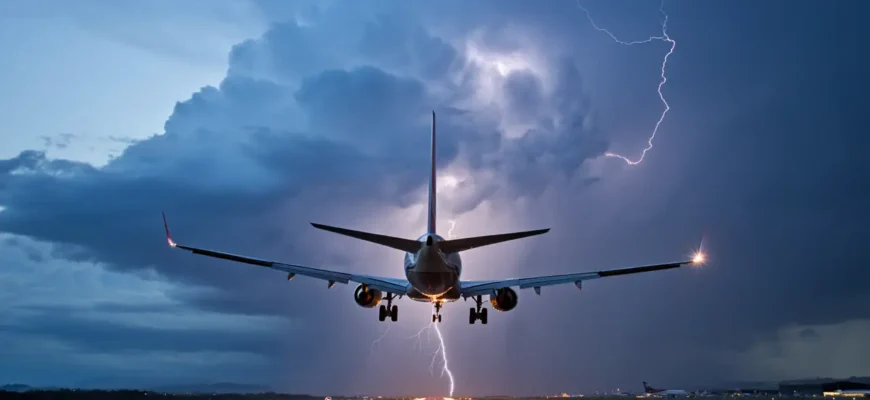
Sometimes an airplane touches the ground softly, almost imperceptibly, and other times — as if it slams with full force into a washboard and rattles along it for a good couple of minutes.
Landing is always a lottery. Dissatisfied passengers might loudly grumble at the pilot, suggesting they should be more careful. But that’s unfair, because in such moments the pilot is looking out for their safety, trying to cope with circumstances beyond their control. Let’s figure out exactly what those circumstances are.
High Humidity
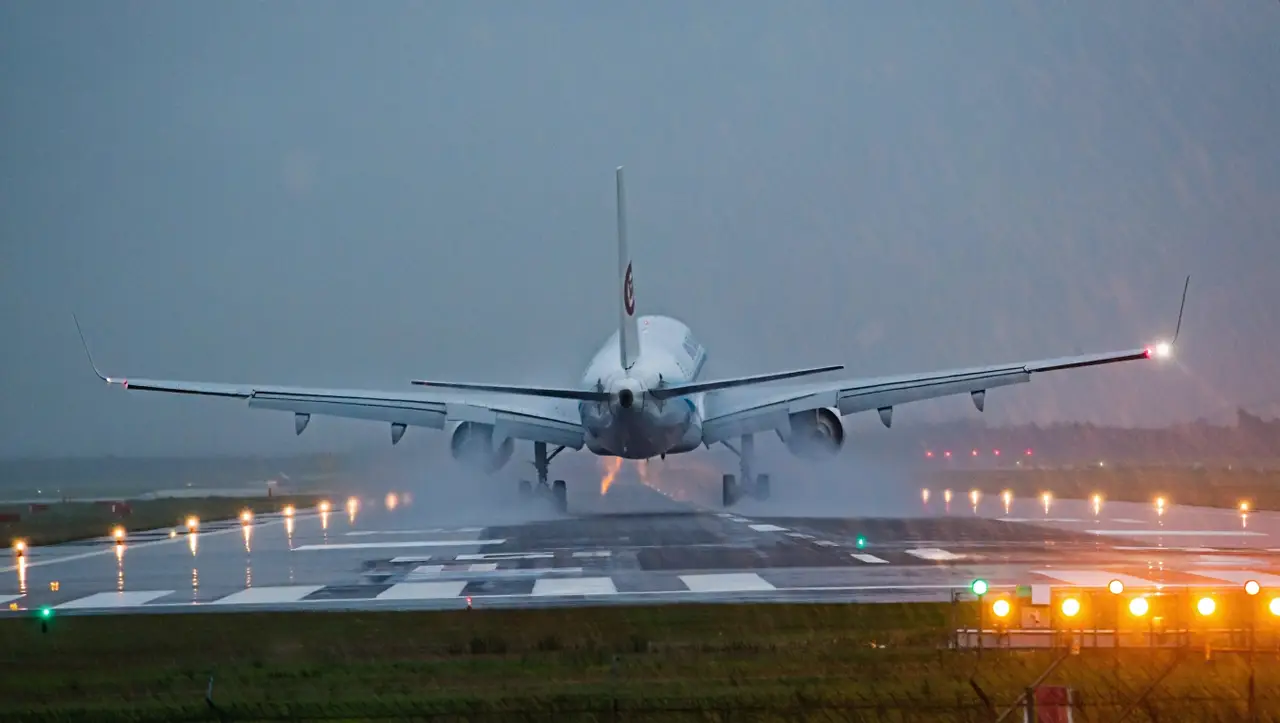
In gloomy, rainy, or snowy weather, a very thin layer of water forms on the runway. If the aircraft touches the ground smoothly, it simply cannot grip the surface, will slide forward, and fail to brake in time. To prevent this, the aircraft is literally forced down onto the ground, ensuring sufficient friction with the runway.
Gusty Wind
Wind is another dangerous whim of the weather: due to sharp gusts that intensify near the ground, the plane can shake noticeably, and even the most skilled pilot has no power to influence the elements. There are many places on the planet where nature rages with full force. For example, Narsarsuaq Airport in Greenland is located right next to a fjord, so powerful wind and turbulence turn landing into a real trial. Kansai Airport in Japan is built on an artificial island, and the pilots’ work is complicated by earthquakes, cyclones, and seabed instability. And in Hong Kong’s Kai Tak, squeezed in a dense ring of skyscrapers and mountains, such strong crosswinds blew that in 1998 the airport was relocated to a new site (the main reasons also included a lack of space for expansion and difficult terrain).
Type of Aircraft
Soviet-built aircraft, such as the Tu-154 or Il-86, were designed for a soft landing: before touchdown, pilots would hold them above the ground at a height of about 1 meter, thereby achieving a light contact and smooth friction. Modern Boeing and Airbus aircraft land with higher vertical loads due to the design features of their landing gear and flare procedures.
- Anti-stress travel: which countries actually lower cortisol levels
- Why you should dress warmer on a plane and how it relates to safety
- How to deal with aerophobia?
Uneven Runway
The quality of the surface also matters: if it is even and smooth, the landing will be softer, but if it needs repairs, you will have to bounce around a bit. The surface of the airfield at Mariscal Sucre Airport in Ecuador was so bumpy, the surrounding terrain so complex, and the fogs so thick and frequent, that in 2013 a new modern aviation hub, better equipped and more favorably located, was opened to replace it.
Almost in the center of the runway at Courchevel Airport, a significant hill rises. And on one of the runways at Savannah Airport, the unevenness is simply eerie: the tombstones of Mr. and Mrs. Dotson, who owned these lands in the 19th century, are embedded into the pavement.
The main runway of Gisborne Airport in New Zealand is crossed by a railway line, and at Barra Airport in Scotland, airplanes land right on the beach. It is unlikely that in such conditions anyone would think to scold the pilot for a hard landing.