New data reshapes our understanding of Wolf-Rayet stars.
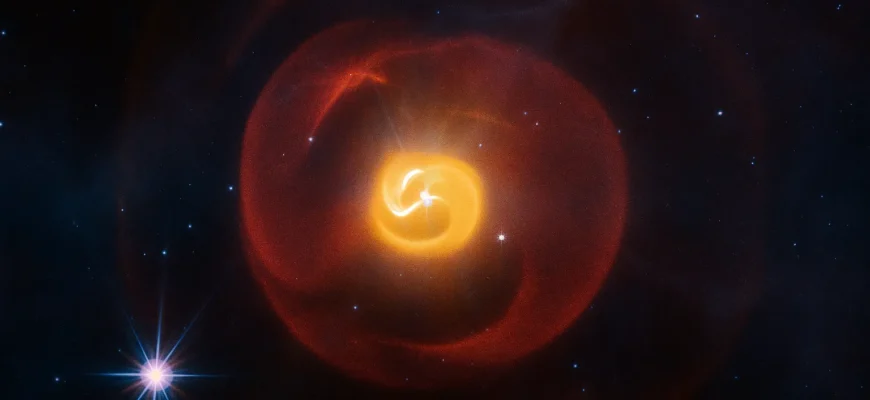
Scientists have named two stars surrounded by a massive dust spiral, resembling a serpent devouring its own tail, Apep — after the Egyptian god of destruction. Now, this object has been observed using the James Webb Space Telescope. The newly published data, shared in two arXiv preprints, has proven fascinating, reports The Conversation.
Wolf-Rayet stars are massive stars shedding their outer hydrogen layers before exploding. When the fierce winds of a Wolf-Rayet star collide with the wind of its weaker companion, they compress. At the heart of this storm, a dense, cool environment forms, where carbon-rich winds can condense into dust. The first carbon dust in space—the very particles that make up our bodies—originated in this way.
Dust from the Wolf-Rayet binary is blown outward in an almost straight line, while the stars’ orbital motion twists it into a spiral nebula—like water from a sprinkler.
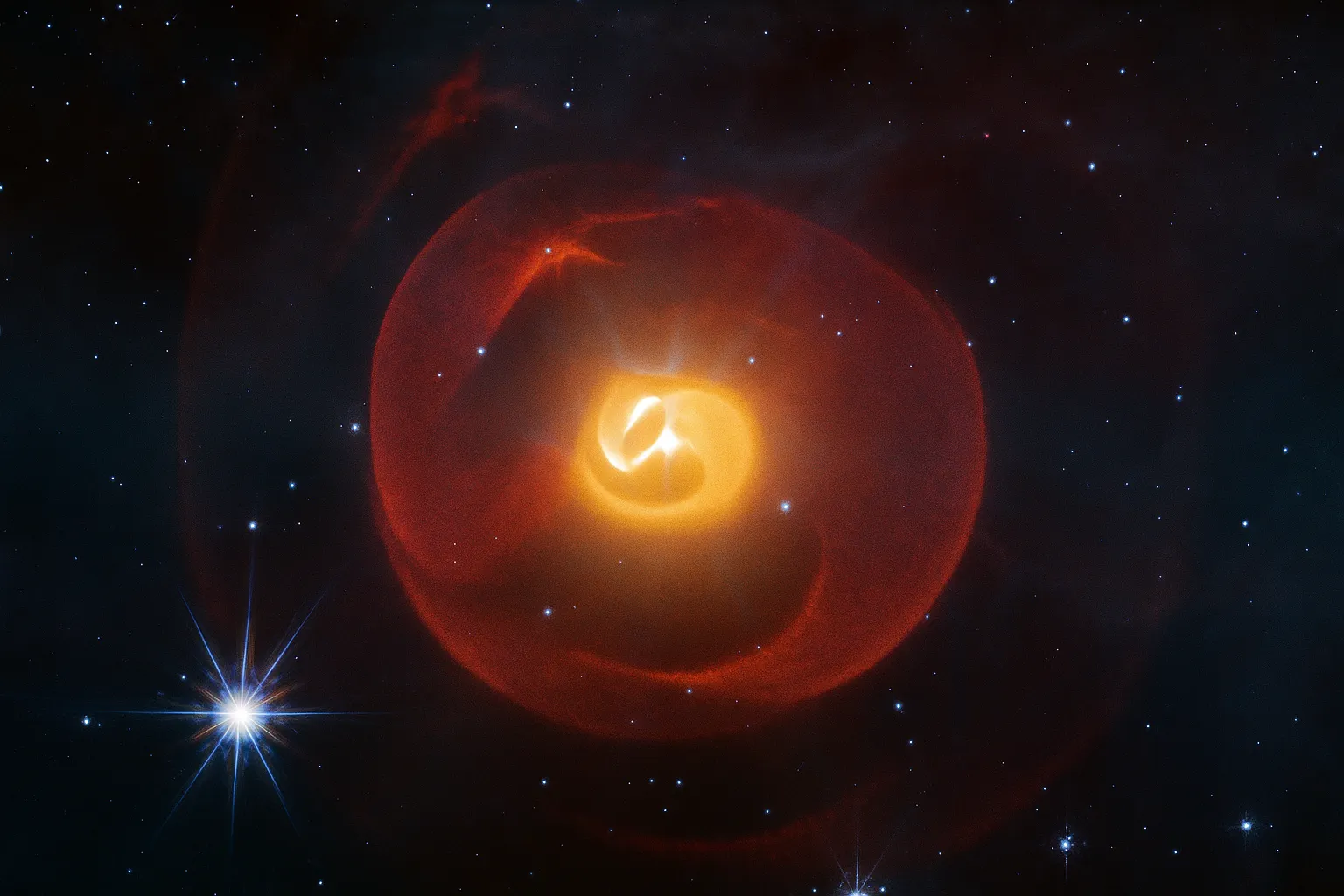
Webb’s camera revealed hot regions in blue and cooler ones in red. It also confirmed the presence of a third, more distant star, first noted in 2018. It is this star’s wind that “chews through” the dust shell, creating a noticeable gap.
The new data revealed three evenly spaced dust layers, each cooler than the last. This allowed for a more precise distance estimate to the system—turns out, it is farther away than previously thought, meaning the stars are brighter than expected.
Studying Apep not only helps us understand how stars die and where carbon dust comes from but also showcases the breathtaking beauty of the cosmos, where even the chaos of stellar death obeys the laws of geometry.