What Is Heat Lightning and Should You Be Afraid of It? How This Phenomenon Differs From Lightning
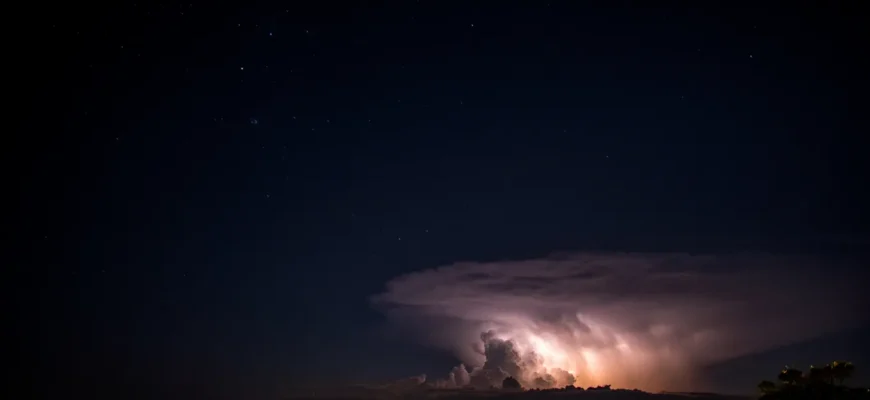
On a summer evening, when the last rays of the sun have already faded and the sky above has darkened, you may sometimes see a brief yet noticeable flash. It doesn’t sting your eyes, but instead softly illuminates the edge of the horizon or the clouds as if from within. There is no rumble, no thunder — only a fleeting play of light in the distance.
This phenomenon was poetically and precisely named by our ancestors — heat lightning. It is wrapped in silence and seems like a mysterious messenger of distant storms. But what is really hidden behind this heavenly phenomenon? And how is it connected to a thunderstorm?
What Is Heat Lightning
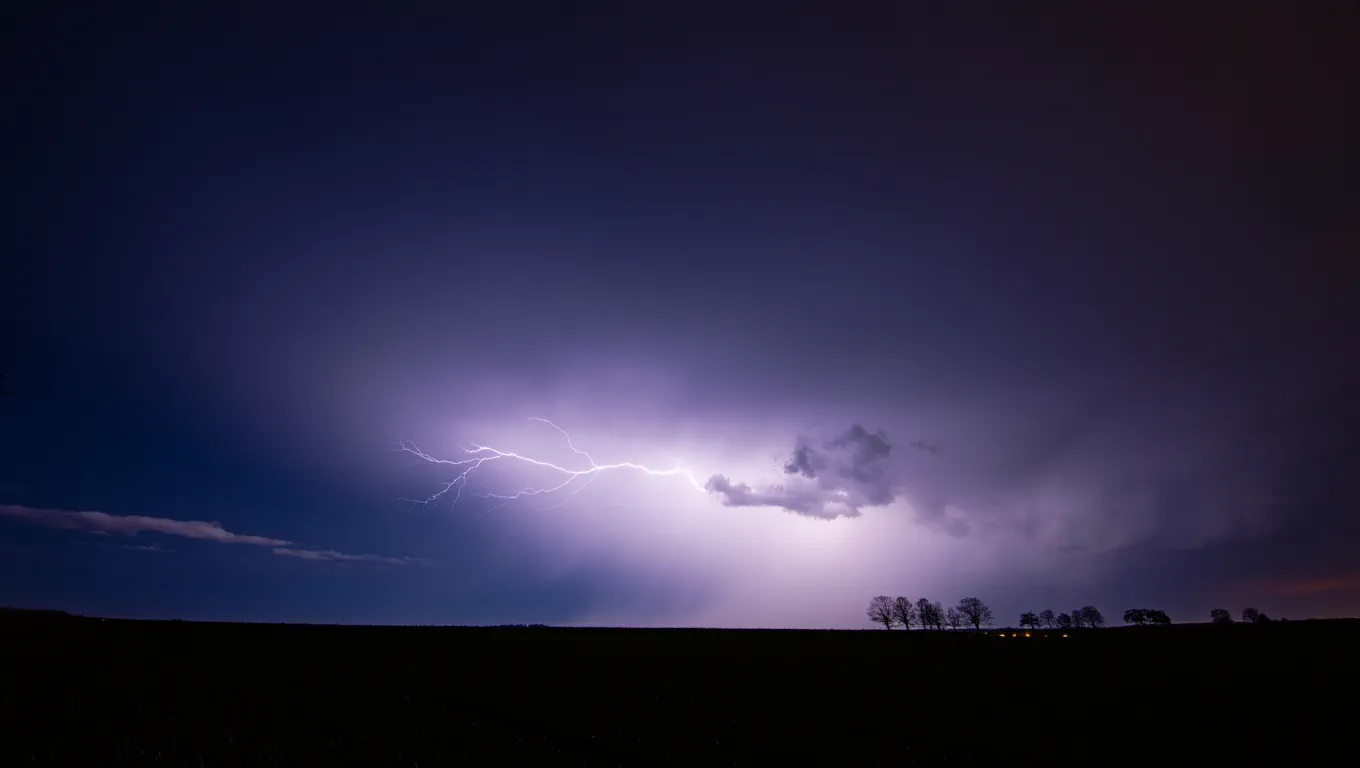
Imagine a powerful thunderstorm raging dozens or even hundreds of kilometers away. At its center, real lightning bolts flash — giant electric discharges tearing through clouds or striking the ground. These flashes are blindingly bright and accompanied by deafening thunder. But sound is tricky. It travels much more slowly than light and loses its power, dispersing in the air over long distances. Light, on the other hand, reaches us almost instantly and can travel enormous distances.
A ray from such a distant lightning strike shoots upward. On its way, it meets dense layers of clouds — maybe those directly above the storm, or others lying between the storm front and you. These clouds act as a massive natural screen. Because of the Earth’s curvature, we cannot see the lightning itself, but its light, once it hits the clouds, is reflected many times by droplets and ice crystals, scattering and spreading sideways.
As a result, what reaches us is not the sharp flash of the lightning strike but its diffused glow. This soft, often ocher or reddish light evenly illuminating a patch of sky on the horizon without a clear source is what we call heat lightning. In essence, heat lightning is the reflected and scattered light of a thunderstorm lightning strike happening so far away that the thunder never reaches us.
How Heat Lightning Differs From Lightning
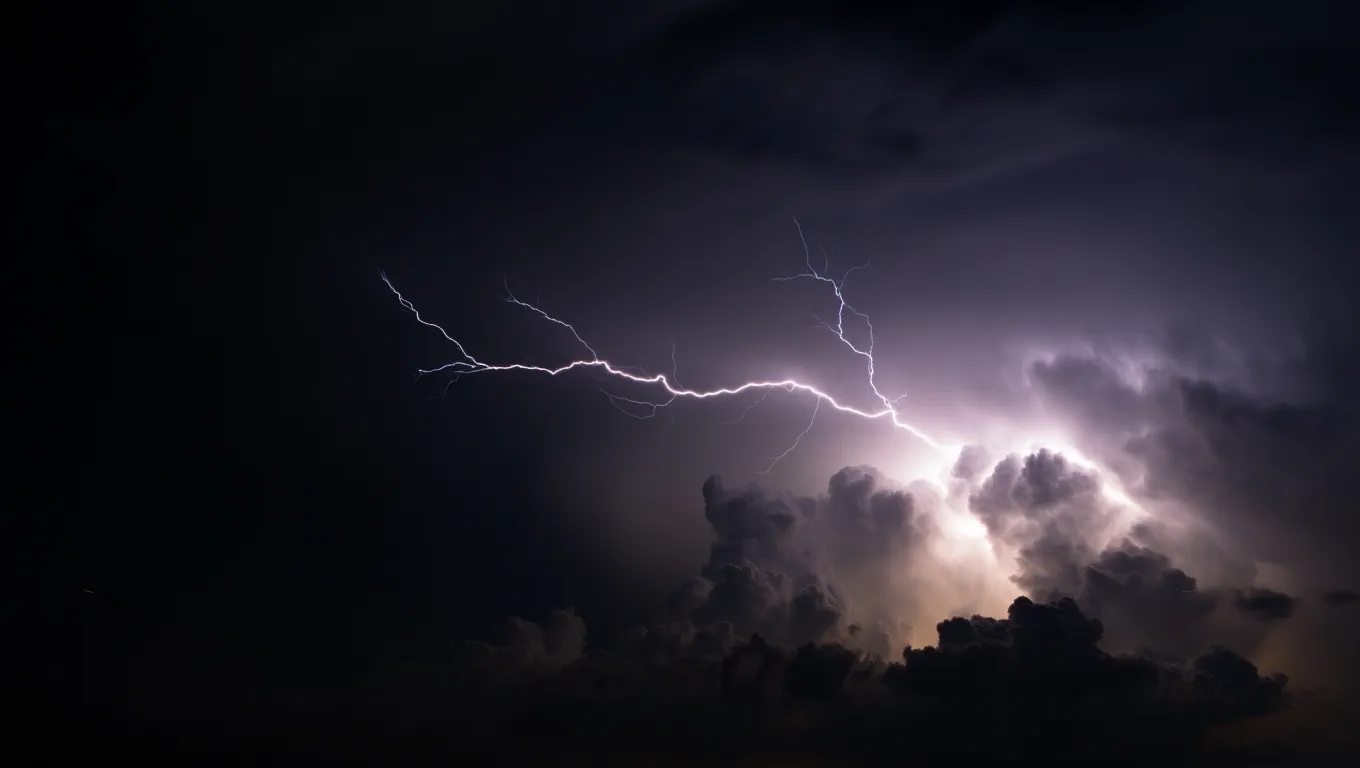
Although heat lightning is caused by lightning, they are fundamentally different phenomena.
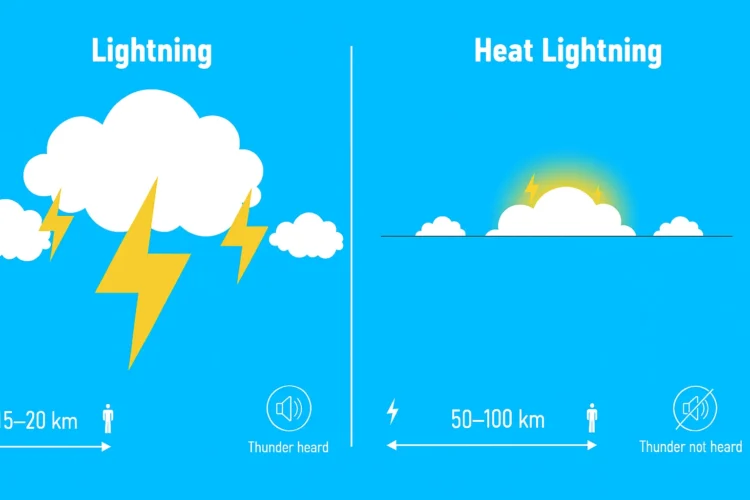
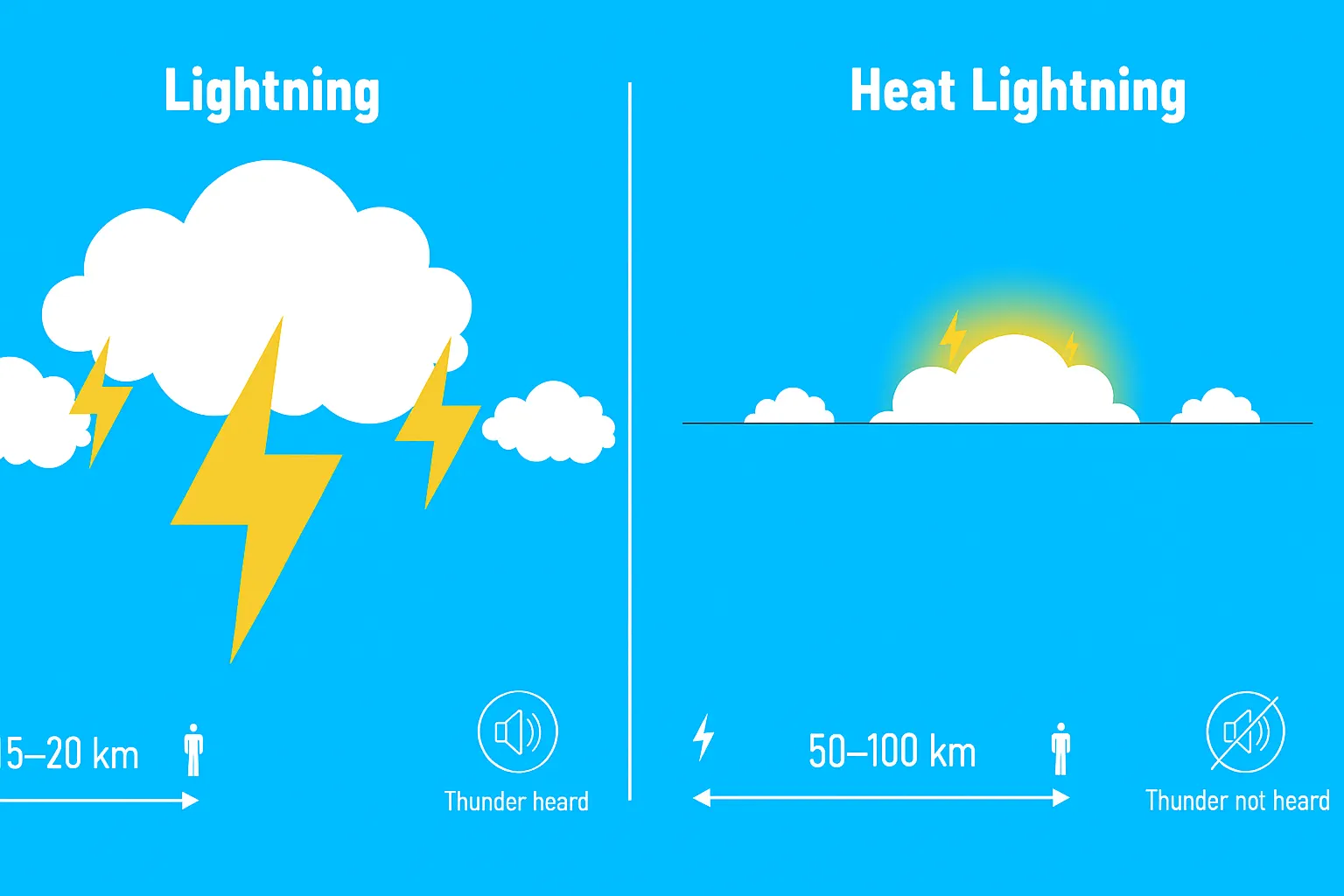
- Nature of the phenomenon. Lightning is a powerful electrical discharge caused by enormous tension between parts of a cloud or between a cloud and the ground. Heat lightning, however, is only the light that reaches us, reflected from that distant strike. No electrical discharge occurs in the place where you see the glow.
- Sound. Lightning is almost always accompanied by thunder — loud, frightening, sometimes shaking the ground. Heat lightning, however, is observed in complete silence.
- Appearance. Lightning is a sharp, often zigzag-shaped flash or a bright burst of light inside a cloud. It is very intense. Heat lightning, on the other hand, appears as a soft, widespread glow without sharp outlines.
- Distance. If you see lightning and hear thunder, the storm is close, within 15–20 km. Heat lightning, however, is a sure sign of a very distant storm, 50–100 km away or even farther.
- Color. A bright lightning bolt is usually white or bluish because of the extreme discharge temperature (up to +30,000 °C). The light of heat lightning, traveling huge distances through the atmosphere and reflecting in the clouds, often loses part of the blue spectrum. That’s why it looks yellowish, orange, or reddish, especially at sunset or sunrise when the air itself is filled with warm tones.
When Heat Lightning Occurs

Heat lightning is mainly a phenomenon of the warm season, although theoretically, it can be seen in winter too. Most often, people notice heat lightning on summer evenings and nights, as well as in the pre-dawn hours. This is because summer is the season of the most active and frequent thunderstorms, especially in the central regions. The more thunderstorms around, the higher the chance of seeing heat lightning.
The dark time of day is the ideal backdrop for observation. The soft glow of heat lightning simply disappears against the bright daytime sky. In addition, in the evening and at night, stratiform or stratocumulus clouds often form or persist, which are perfect for scattering and reflecting the light of distant lightning strikes. Plus, cooler and denser night air can sometimes carry light a little farther.
Frequent and bright flashes on the western or southwestern horizon in the evening may be a sign that the thunderstorm, whose light you see, is moving toward you with the prevailing wind. Perhaps by morning or the next day the bad weather will reach you as well. But this is not guaranteed — the storm may pass by.
Is Heat Lightning Dangerous to Humans

Heat lightning is only the light reaching you from a lightning strike that happened very far away. It’s the same as looking at the reflection of lightning in a giant mirror located beyond the horizon. No electrical discharge, no thunder, no physical processes associated with a thunderstorm take place in the spot where you observe heat lightning. It is purely an optical phenomenon.
Therefore, when you see heat lightning, you can simply enjoy the spectacle. Heat lightning is one of the most beautiful atmospheric phenomena. It is not a harbinger of a lightning strike, but only a luminous message from a storm already raging somewhere beyond the horizon.