Lyon (France) – detailed information about the city with photos. Main attractions of Lyon with description, guides, and maps.
City of Lyon (France)
Lyon (French: Lyon, Latin: Lugdunum) is a city in eastern France and the capital of the Auvergne-Rhône-Alpes region. It is the third-largest city in the country and the second most important after Paris. Lyon does not often appear on tourist routes, although it has a rich history dating back centuries to the period of Ancient Rome. The city has preserved a superb historic core, which is a UNESCO World Heritage site and includes the oldest ancient ruins in France, charming medieval streets, atmospheric neighborhoods along the Saône and Rhône rivers, as well as beautiful Renaissance houses. Lyon is known for its gastronomy, cultural life, and as the birthplace of cinema. It was here that the Lumière brothers began producing their cinématographes.
Geography & Weather
Lyon is located in southeastern France at the confluence of the Rhône and Saône rivers, approximately 400 km from Paris. The city lies on the Rhône plain and is surrounded by gardens and vineyards. The Central Massif rises to the west, while the Alps are located to the east. The climate is temperate continental with some influence from the Mediterranean Sea. Winters are cool, with cold winds and minimal snow cover. Summers are dry, hot, and sunny.

Practical Information
- Population — over 500,000 inhabitants.
- Area — 47.87 km².
- Language — French.
- Currency — Euro.
- Visa — Schengen.
- Time — Central European UTC +1, summer +2.
- Festival of Lights (fête des Lumières) — the most important annual event in Lyon. Lasts four days from December 8th.
- Main shopping districts: La Part-Dieu (Boulevard Vivier-Merle), Rue de la République, Rue du Président Edouard Herriot, rue Gasparin, rue Emile Zola, rue des Archers, rue du Plat.
- Traditional Lyonnaise restaurants are called bouchons. They are usually open for lunch (from 12:00 PM to 2:00 PM) and dinner (from 7:30 PM to 10:00 PM). Service charge is always included in the bill. Traditional local food: salade lyonnaise (green salad with bacon, croutons, and a poached egg), saucisson chaud (sausage in wine or on a roll), quenelle de brochet (pike dumplings), tablier de sapeur (marinated meat pieces coated in breadcrumbs), andouillette (sausage made from chopped meat with mustard sauce), gratin dauphinois (potatoes with cream), rognons de veau à la moutarde (veal kidneys in mustard sauce), cervelle de canut (fresh cheese with garlic and herbs).
How to Get There
The most convenient way to get to Lyon is to fly to Paris. A low-cost train runs directly from Paris airport, taking you straight to Lyon in 2 hours (prices from €10). The only caveats: if you have large luggage, purchase a separate seat for it when buying your ticket (€5). Another option is a flight Vilnius – Grenoble (Wizz Air); from Grenoble to Lyon is only 120 km. Lyon’s own airport is located 25 km east of the city. It serves the following destinations: London, Rome, Paris, Madrid, Berlin, Brussels, Toulouse, Bordeaux.
Lyon is connected by high-speed rail to Paris, Brussels, and Marseille.
The city is a major transport hub and is located near highways leading to Paris, Marseille, Grenoble, Spain, Italy, Germany, and Switzerland.
History & Interesting Facts
Lyon is one of the oldest cities in France. As early as between the 3rd and 1st centuries BC, the Gallic tribe of the Segusiavi organized a trading place at the confluence of the Rhône and Saône rivers. Later, a fortress called Lugdunum arose on the Fourvière hill. In 43 BC, the settlement was captured by the Romans and became a Roman colony. The Romans significantly expanded and rebuilt Lugdunum. The settlement had important commercial and military significance. Many Roman emperors visited it, and Claudius and Caracalla were born here.

Under the Romans, Ancient Lyon prospered and was effectively the capital of Gaul. The peak period of prosperity occurred during the 1st and 2nd centuries AD. Among the many Roman structures, a theater, an odeon, an amphitheater, aqueducts, and baths have survived to this day. At the end of the 2nd century AD, after the battle between Septimius Severus and Clodius Albinus, the city was looted and burned. After this, Lugdunum declined.
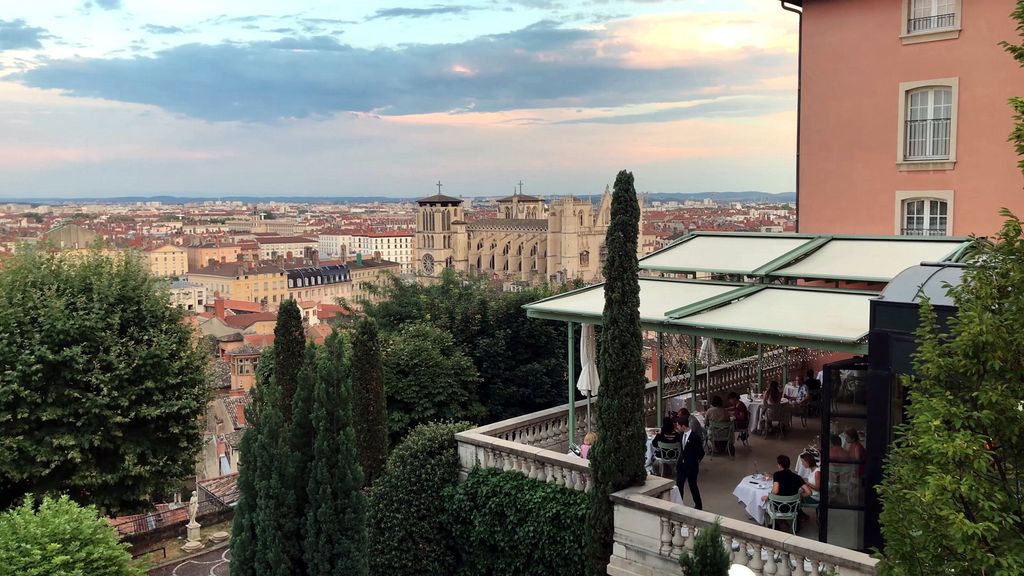
In the 5th century, Lyon ceased to be the capital of Gaul and was captured by the Burgundians. In the first half of the 6th century, the city came under Frankish control. During the 6th-7th centuries, it experienced constant raids and looting. Lyon began to prosper again during the reign of Charlemagne. After the collapse of the Frankish Empire, power over the city passed to the church. In the 12th century, Lyon was divided between Germany and France along the Saône river.
In the 13th century, two significant religious events took place in Lyon — the Lyonnais Councils. At one of them, an attempt was even made to unite with the Orthodox Church. At the beginning of the 14th century, Lyon was annexed to the French kingdom, which ended the power of the archbishops. In the 15th and 16th centuries, the city prospered thanks to trade. In 1563 and 1574, plague raged in Lyon, claiming the lives of a third of the city’s inhabitants.

During the French Revolution, Lyon sided with the opponents of the National Convention. The citizens rose against the Jacobins and overthrew their dictatorship. After this, the Convention declared the city an enemy of the revolution. General Kellermann’s army laid siege to Lyon, and after a brutal two-month siege, it was taken. On October 12, 1793, a decision was made to destroy it. The Jacobins virtually destroyed the Old Town and killed half the population. Lyon only began to revive during the reign of Napoleon.
Attractions & Sights

Lyon’s Old Town is its main attraction. It has over 2000 years of history and is a UNESCO World Heritage site. Despite the scars left on the “city’s face” after the French Revolution, Lyon has preserved unique monuments from antiquity, the Middle Ages, and modern times.
The oldest part of Lyon is the Fourvière hill, where the Gallic settlement and Roman city were founded. Later, the city grew from east to west, occupying two more hills and the confluence of the Rhône and Saône. Four historic districts cover an area of 500 hectares and will literally transport you to Lyon’s past.

On the Fourvière hill, you can discover the ruins of ancient Lugdunum — the capital of Roman Gaul. Two ancient theaters recall the city’s greatness and prosperity. The Great Theater was built in the 1st century BC and expanded in the 1st century AD. The theater could hold 10,000 spectators. Nearby is a small odeon, which the Romans used for concerts and public readings. The Archaeological Museum is also located nearby, preserving all the ancient discoveries and finds.
The Amphitheater of the Three Gauls was built in 19 AD outside the Roman city and expanded under Hadrian. This structure was used for gladiatorial games. Also, once a year, representatives of the Gauls gathered here to pledge allegiance to Rome. The amphitheater was discovered in the 19th century.
Ancient Lugdunum was supplied with water by four aqueducts. They delivered clean water to the city from the surrounding mountain ranges and stretched for several tens of kilometers.
 Basilica of Notre-Dame de Fourvière is one of the main landmarks of Lyon, located at the top of the namesake hill overlooking the Saône. This stunning eclectic basilica was built in the 19th century after the Franco-Prussian War, when the inhabitants of Lyon vowed to create a church dedicated to the Virgin Mary if the city was spared. The building is a mix of Gothic and Byzantine styles with a richly decorated interior. It is also worth climbing here for the beautiful panorama of Lyon.
Between the Fourvière hill and the Saône lies Vieux Lyon (Old Lyon) with its charming Renaissance alleyways. These narrow streets with merchant houses from the 15th and 16th centuries retain the atmosphere from the time when Lyon was a fair city.

Saint-Jean-Baptiste Cathedral is a magnificent medieval cathedral in Romanesque style with a French Gothic facade. It was built in the 12th century and is known for its beautiful stained glass windows from the 13th-14th centuries. The rose window on the facade dates from the late 14th century, and the astronomical clock dates from the 16th century.
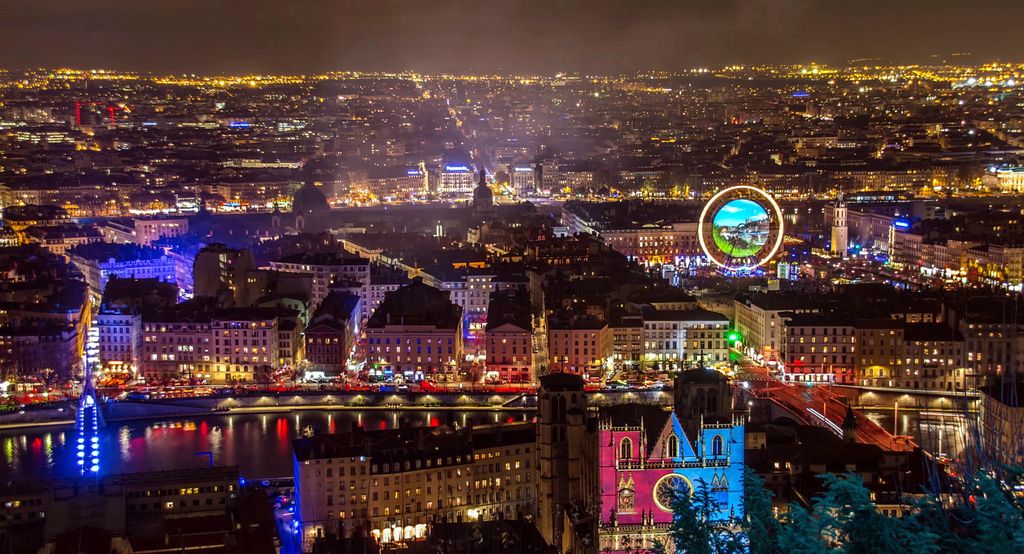
The medieval quarters around the Saint-Jean cathedral are among the most charming in Old Lyon. North of the church, there are plenty of charming narrow cobbled streets and quiet little courtyards. On the picturesque Place Neuve Saint-Jean, there are many traditional restaurants. This district is also home to several interesting museums: the Museum of City History, the Cinema and Miniature Museum, and the Puppet Museum.
On the slopes of the Croix-Rousse hill lies the historic weavers’ district, which was the center of the textile industry in the 19th century. This is one of the most beautiful places in Lyon, with many narrow sloping streets and charming curved staircases.
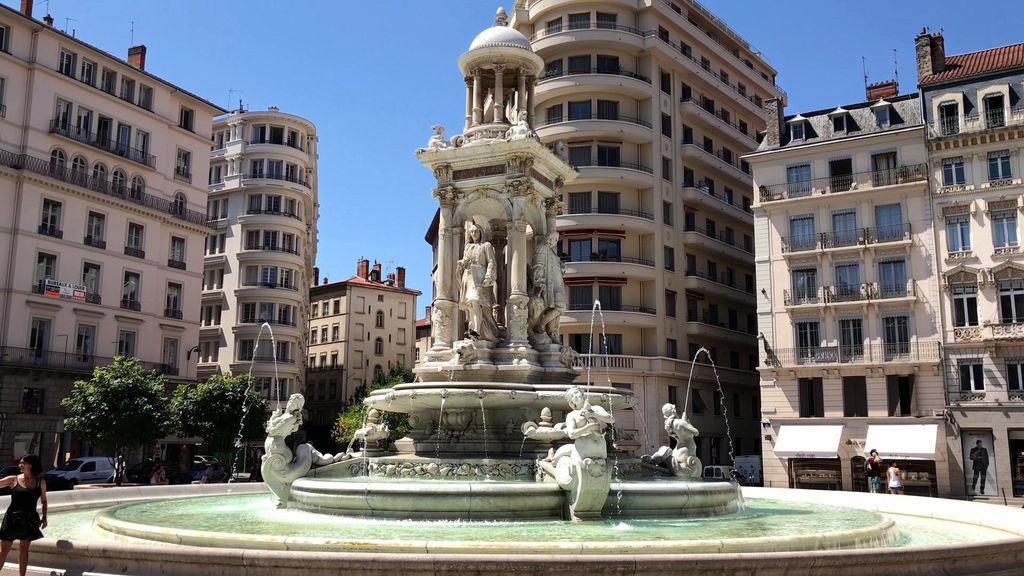
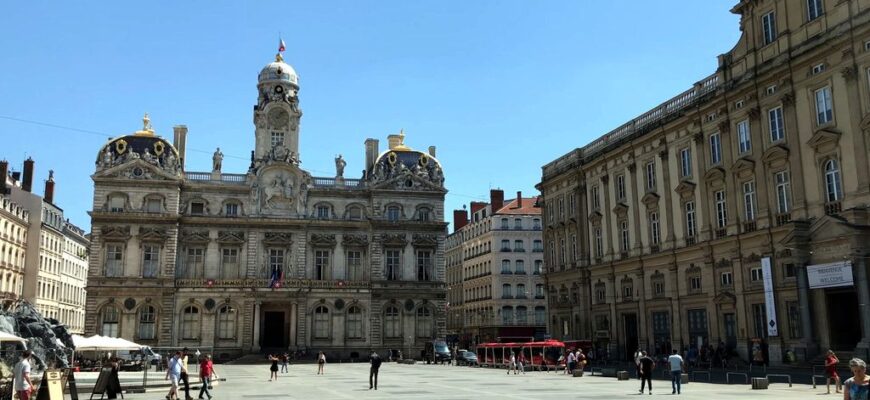
The Presqu’île district features beautiful architecture and monumental city squares. Here you can see many magnificent Baroque and Renaissance-style buildings. In front of the City Hall is the grand Bartholdi Fountain. The central square of this district is Place Bellecour, surrounded by elegant 19th-century buildings. In the center of the square stands an equestrian statue of Louis XIV.

Temple du Change (Temple of Change) is an 18th-century historic building designed by architect Jean-Baptiste Roche. It was used by Lyonnais merchants as a stock exchange. The building was abandoned after the Revolution.
Church of St. George is a 19th-century Neo-Gothic church on the banks of the Saône. It was built by architect Pierre Bossan and is a historical monument.

Church of St. Irenaeus is a 19th-century Neoclassical church built on the site of an older Carolingian-era religious building. Ancient stone sarcophagi from a Roman necropolis are preserved within the church walls.
Church of St. Martin is the only fully Romanesque church in Lyon, dating from the late 11th century. It was built on the site of an ancient Carolingian church (9th century). From the 13th century, the church was part of an abbey of the same name, which was closed after the Huguenot wars. The church was heavily damaged during the French Revolution and was threatened with destruction in the 19th century, but fortunately, it was saved and reconstructed.
Church of St. Bonaventure is an ancient church in French Gothic style. It was founded in 1220, rebuilt in the 14th century, and again at the end of the 15th century. The church has the most beautiful organ in Lyon and old Aubusson tapestries.
Church of St. Nizier is one of the oldest religious buildings in Lyon. The first church on this site was built in the 6th century, although the first Christians gathered here as early as the 2nd century. The building was rebuilt in the Gothic style between the 14th and 15th centuries.
Hotels & Accommodation in Lyon
Lyon is a very convenient city in terms of public transport, so it doesn’t really matter which district you choose to stay in. The most beautiful district of the city is considered the center – on the Presqu’île (peninsula) between the two rivers. Guillotière, which has become popular with Arab immigrants, can be slightly dangerous at night.

Decent hotels in Lyon can cost, on average, from €50 per night. Pay attention to these hotels.
Hôtel Axotel Lyon Perrache (12, rue Marc Antoine Petit). A hotel in a very original building – will appeal not only to architects. Room from €49 for two.
Hôtel Victoria Lyon (3 rue Delandine). A pleasant two-star hotel in the center, excellent breakfasts, although parking is paid. Another bonus – a night store around the corner. A double room will cost €59.
Hôtel Du Dauphin (9 rue Victor Hugo) – a small hotel with a pleasant atmosphere. It has an ideal location — not far from the Perrache train station and the main square of the city, Bellecour, in a quiet area.
If you plan to come to Lyon for a specific major event (football match, festival, etc.), it’s better to arrange accommodation in advance. Proven: a week before, either everything is booked or very expensive.