Nestled between the Alps and a mirror-like lake, Hallstatt charms with gingerbread houses, ancient salt mines, and mountain views. Your guide to Austria’s postcard-perfect village.
The town of Hallstatt (Austria)
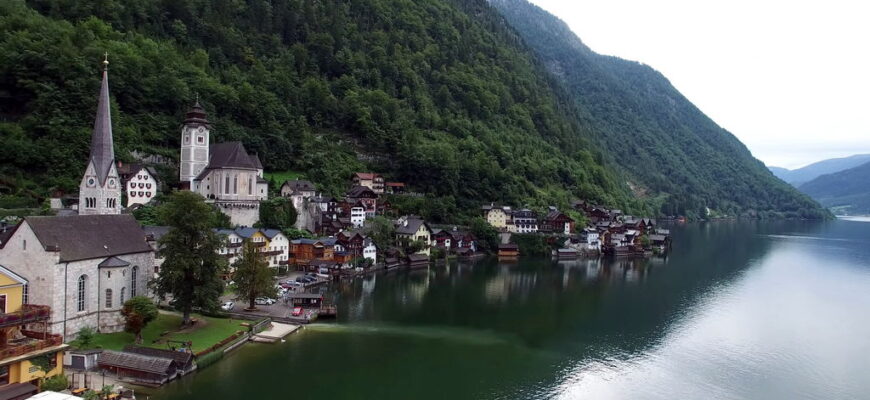
Hallstatt (German: Hallstatt) — a small, charming village (municipality) in Western Austria, located in a picturesque setting on the western shore of the lake of the same name, surrounded by the Alps. Hallstatt is essentially a tiny village lost among mountains and forests. It features beautiful gingerbread houses reflected in the purest water of a mountain lake, narrow streets, a few small ancient churches, and fantastic natural landscapes.
Until the 19th century, Hallstatt was practically inaccessible to the general public. The village could only be reached by boat or a narrow mountain path. Today, a mountain road leads here, and this place has become one of Austria’s landmarks. The municipality is a UNESCO World Heritage Site.

Geography and Weather
Hallstatt is located in the Upper Austria region on the shore of Lake Hallstatt. The municipality lies between the southwestern shore of Lake Hallstatt and the steep slopes of the Dachstein massif in the Salzkammergut geographical area, on the national road connecting Salzburg and Graz.
The climate is temperate mountainous with fairly warm summers and cool winters. Annual precipitation exceeds 1000 mm, most of which falls during the warm period. In winter, frosts are usually mild. Fog is possible during the cold season.

Practical Information
-
Population — about 750 people. Tourists in the high season number in the thousands, so it can be crowded in this small town.
-
Area — 59.8 square kilometers.
-
Language — German.
-
Currency — Euro.
-
Visa — Schengen.
-
Time — Central European UTC + 1, summer + 2.
-
In Hallstatt, it is worth visiting the famous salt mines, taking a boat ride on the lake, or going for a hike in the mountains.
-
Regarding food, you should try local fish dishes, König Ludwig Dunkel Brau beer, and traditional red beer.
-
As souvenirs, you can buy various salt products.
History
A settlement on the site of modern Hallstatt existed as early as the Neolithic era. In the mid-19th century, archaeologists discovered a prehistoric cemetery with more than a thousand graves. Many researchers consider Hallstatt one of the oldest settlements north of the Alps.
Since the 8th century BC, salt has been mined here in shafts that are among the oldest of their kind in the world. Many Bronze Age artifacts have also been found here.

There is practically no data on the settlement in the era of Ancient Rome and the Early Middle Ages. The first mentions of Hallstatt date back to the 14th century. At the end of the 16th century, a salt pipeline was built to Ebensee. The first road was built here at the end of the 19th century.
How to Get There
Getting to Hallstatt is quite difficult. From Salzburg and Vienna, you need to take a train to Attnang-Puchheim, then a train to Hallstatt station (or Obertraun), get off at Hallstatt station, which is located on the opposite shore of the lake, walk to the pier and board a ferry. Return train tickets can be bought from a special machine. The nearest airports are in Vienna and Salzburg. You can get to Hallstatt from Prague with transfers, often via Český Krumlov or Linz. From Salzburg, there are also direct buses to Bad Ischl, from where you can travel by train or bus.

You can get to Hallstatt by car via a picturesque mountain road. At the entrance to the village, there are several parking lots.
Sights and Landmarks
Hallstatt itself is a landmark. A fantastically beautiful place with wonderful nature and cute houses, which, however, is a bit overcrowded with tourists.

Salt Mine — one of the main attractions of the village. It is considered the oldest in the world, and salt mining continues here to this day. A special tourist route is open for visitors.
Hallstatt Museum — one of the most interesting places in the town, opened in 1884. It includes exhibits dedicated to the Bronze Age culture.

Church of Christ — a small Protestant church from the late 18th century. It is one of the symbols of Hallstatt. If you walk further from the church, you can reach an observation deck. This is where all the most beautiful and famous photos of the town are taken from.
In the southwestern part of the town is a charming little Market Square.

Church of the Assumption of the Virgin Mary — a Roman Catholic parish church with a Romanesque tower, three beautiful winged altars, and late Gothic frescoes dating back to approximately the 16th century.
Cable Car can take you to the Dachstein caves and to the top of the mountain. The journey takes about fifteen minutes.
You can also visit the Ossuary (Bone House) with a collection of painted skulls.
Video

“`