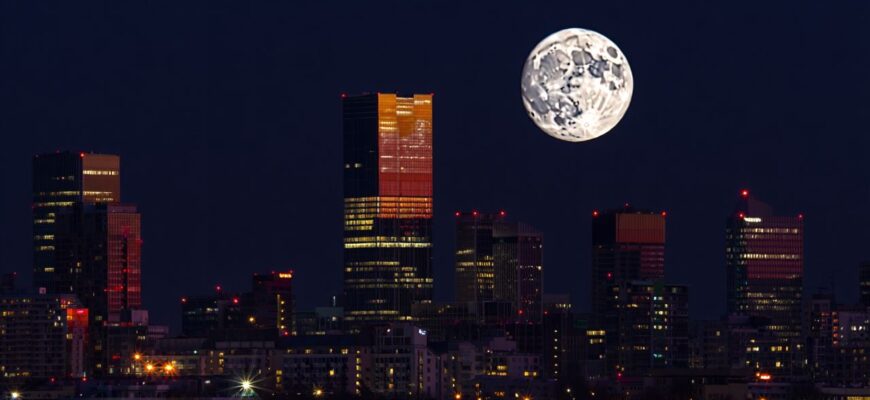
Why does the Moon look big sometimes and small at other times? Does it get closer to Earth and then move away? Or perhaps Earth’s atmosphere affects it? What about a lens effect? With these questions, “Mandry” turned to the experts.
Associate Professor of the Hydrometeorological University
Yes, almost every one of us would say that the Moon appears larger when it is visible near the horizon. Why does this happen? Perhaps the distance from the Earth to the Moon really changes, since we know that the Moon’s orbit is not circular, but elliptical?
Let’s try to estimate the change in the apparent angular size of the lunar disk. At apogee (the farthest distance), the Moon is 405,700 km away from Earth. At perigee (the closest distance), it is 384,300 km away. Let’s consider the Moon’s diameter—3,476 km. Now, let’s calculate the angular sizes of the Moon. The simplest calculation, accessible to any tenth grader, gives a result at apogee of 0.492°, and at perigee—0.519°. The difference is about 5%. This is not enough to be noticed with the naked eye, without any measuring instruments. The situation is further complicated by the fact that these changes occur slowly, over a lunar month (29 and a half days), and during this time the Moon changes its phase—from Earth, we see a full lunar disk or a part of it, a crescent. It becomes difficult to notice the change in the Moon’s apparent size even with optical instruments.
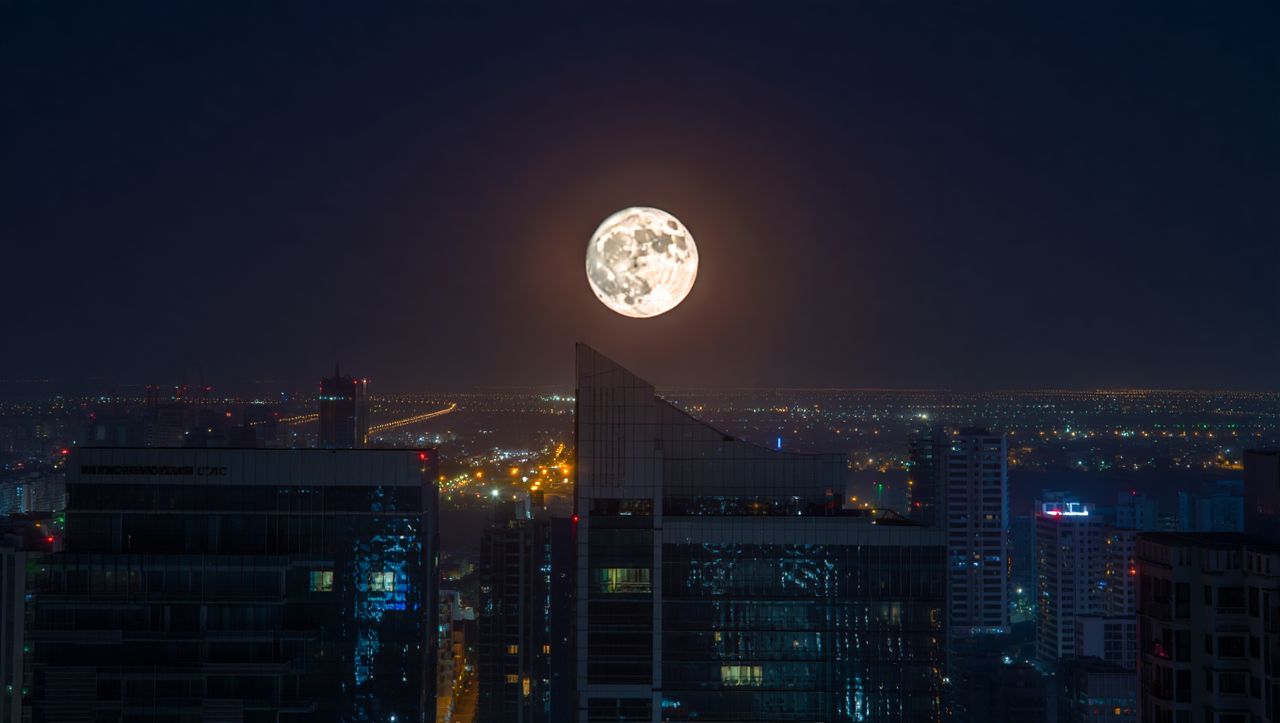
And yet, the Moon seems smaller when viewed at a high angle! Why? At its zenith, we observe the Moon through an almost flat layer of the atmosphere, which does not cause any distortion. The situation is analogous to viewing an object through ordinary thick glass. Near the horizon, however, the atmosphere distorts the image much like the same glass would if it were curved vertically. As a result, the Moon’s image is slightly flattened vertically. However, the Moon does not become larger.
So what’s the deal? It’s quite simple—near the horizon, our eye can compare the Moon’s image with local objects—buildings, trees, etc. When observing it at the zenith, there is nothing to compare it with. We see a lone Moon in a vast sky. Of course, it seems small to us!
To convince yourself of this, try observing a full Moon while holding a precise ruler with millimeter divisions at arm’s length. Try to take identical measurements of the Moon’s apparent diameter near the horizon and at a high angle. You will see that it turns out to be the same!