Plan your visit to Rouen. Find the famous astronomical clock, Saint-Ouen Abbey, and the modern church shaped like flames in the old market square.
The City of Rouen (France)
Rouen is a city in the north of France and the capital of the Normandy region. It is famous for its winding ancient streets and picturesque half-timbered houses, landmarks from the Middle Ages and the modern era, gems of Gothic architecture, and the incredible cathedral that inspired Monet. Rouen is the historic capital of Normandy, sadly known as the place of Joan of Arc’s execution. It is one of the most beautiful cities in France, with a rich history and cultural life.
Geography and Climate
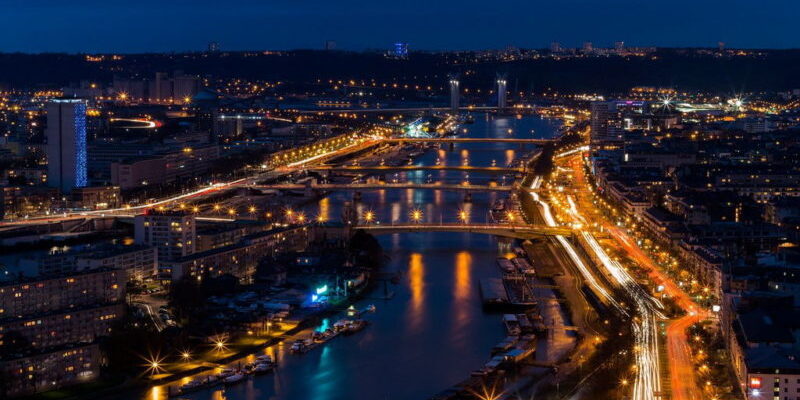
Rouen is located in northern France on the banks of the Seine River, 135 km from Paris. The old town is situated on the right bank of the river. The northern part is quite hilly. The climate is temperate maritime. Winters in Rouen are mild, and summers are warm but not hot.

Practical Information
- Population — over 110,000 people.
- Area — 21.38 km².
- Language — French.
- Currency — Euro.
- Visa — Schengen.
- Time — Central European Time UTC + 1, in summer + 2.
- Rouen is a 1.5-hour drive from Paris via the A13 toll motorway.
-
A market is held every Saturday and Sunday on Place Saint-Marc. You can also buy produce on the Place du Vieux-Marché.
History and Interesting Facts
A settlement on the site of modern-day Rouen appeared over 2,000 years ago and was the centre of the Celtic tribe of the Veliocasses. After the Roman conquest of Gaul, the city, named Rotomagus, was significantly developed during the reign of Octavian Augustus and quickly became the second largest settlement in Gaul after Lugdunum (Lyon). Rouen reached its peak by the 3rd century AD. Baths, an amphitheatre, and other structures were built here. The prosperity of the Roman city was ended by the Germanic invasions in the 4th century.
In the 9th century, Normans began to appear frequently at the mouth of the Seine, plundering and burning Rouen several times. In 911, the city became the capital of the Duchy of Normandy, established by the Vikings. In 941, Duke Richard I of Normandy defeated the combined army of King Louis IV of France, Emperor Otto the Great of the Germans, and the Count of Flanders. In the 10th century, Rouen became a major port city. Throughout the period of Normandy’s independence, it was the capital of the duchy most of the time.

In 1204, Rouen was occupied by French troops. That same year, all of Normandy was annexed to France. In the 13th century, the city prospered thanks to river trade and the textile industry. Rouen merchants held a monopoly on navigation along the Seine almost to Paris. At the end of the 13th and in the 14th centuries, several uprisings occurred due to high taxes. After the last one, local merchants lost all their privileges.
During the Hundred Years’ War, Rouen was occupied by the English and annexed to the possessions of the English king. On May 30, 1431, Joan of Arc was burned at the stake here. Normandy became part of France again only in 1449. After the end of the Hundred Years’ War, Rouen was significantly rebuilt. In the 15th-16th centuries, beautiful Gothic structures were erected here. At that time, the city flourished thanks to fishing, cloth manufacturing, and fairs.

During the period of the Huguenot Wars, part of Rouen’s population joined the Reformation. Tensions between Catholics and Protestants were suppressed by regular troops, who entered Rouen in 1562 and plundered the city for three days. In 1572 (despite the city authorities’ attempts to prevent the massacre), Catholics dealt with the Huguenots.
During the Franco-Prussian War of 1870, Rouen was occupied by German troops. During the First World War, an English military base was located here. During the Second World War, Rouen was occupied by German forces from 1940 to 1944. During this period, the city was repeatedly bombed by Allied aviation. The historic quarters and some landmarks were destroyed by the bombings. The restoration of Rouen lasted 15 years.
Landmarks and Attractions

Rouen is known for its magnificent old town, where on its charming medieval streets you can touch its rich history and enjoy the authentic atmosphere. Around 2,000 old half-timbered buildings have been preserved in the city. Of these, 227 are declared historical monuments. By the number of landmarks — objects of architectural and cultural heritage — Rouen is among the TOP-10 cities in France.

The Cathedral — one of the largest and most stunning Gothic cathedrals in France, located in the heart of the old town. The church began construction in the 13th century. Interestingly, the building was only completed in the 16th century. The cathedral has the highest spire among French churches (151 metres), original stained glass windows, and a superb Gothic facade.

Saint-Ouen Abbey
Saint-Ouen is a Benedictine abbey, famous for its impressive 14th-century church, which is considered a masterpiece of late Gothic architecture. The church has an astonishing Gothic facade and 80 exquisite stained glass windows.
Aître Saint-Maclou
One of the most mysterious and macabre landmarks in Rouen. This is a medieval building that now houses a school of fine arts. Its history dates back to 1348 and the plague epidemic that killed a third of the city’s inhabitants. The space, which is now an inner courtyard, was once used for burying victims of the disease, and the surrounding buildings served as crypts. The building’s galleries are decorated with eerie decor depicting skulls, bones, gravediggers’ tools, and objects of funeral rites.
Palais de Justice
A Gothic masterpiece and an excellent example of medieval civil architecture, built at the beginning of the 16th century. The building has a fine balustrade and an exquisite facade adorned with figures of gargoyles.
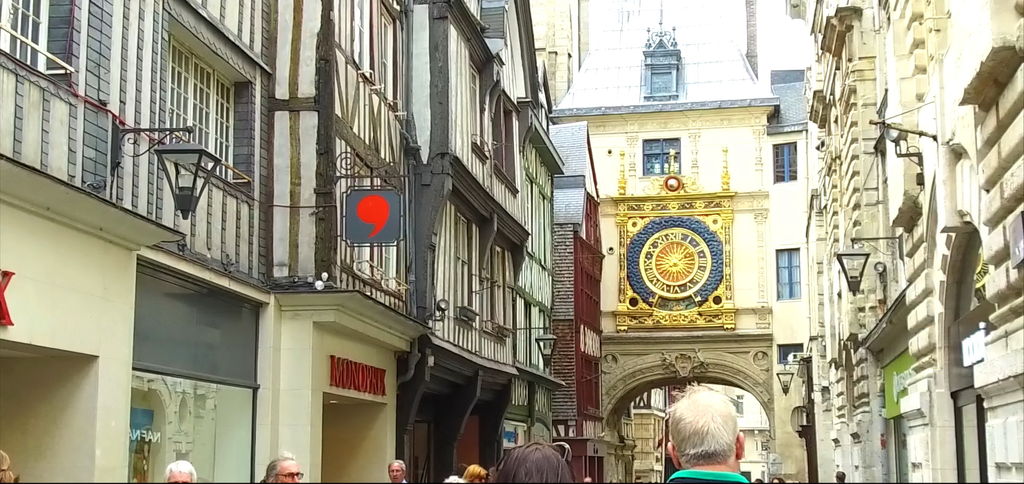
The Great Clock Tower (Gros-Horloge)
One of the main symbols of Rouen. The Gothic belfry was built in 1389 for defensive purposes, and one of the oldest astronomical clock mechanisms in Europe dates from the same period. Interestingly, the clock is still functioning today.
Church of Saint-Maclou
A gem of Gothic architecture, located just a few minutes’ walk from the cathedral. It was built in 1437 and dedicated to the Breton patron saint. The church has a remarkable Gothic facade and structure. The Renaissance-era wooden doors are whimsically decorated with biblical scenes.
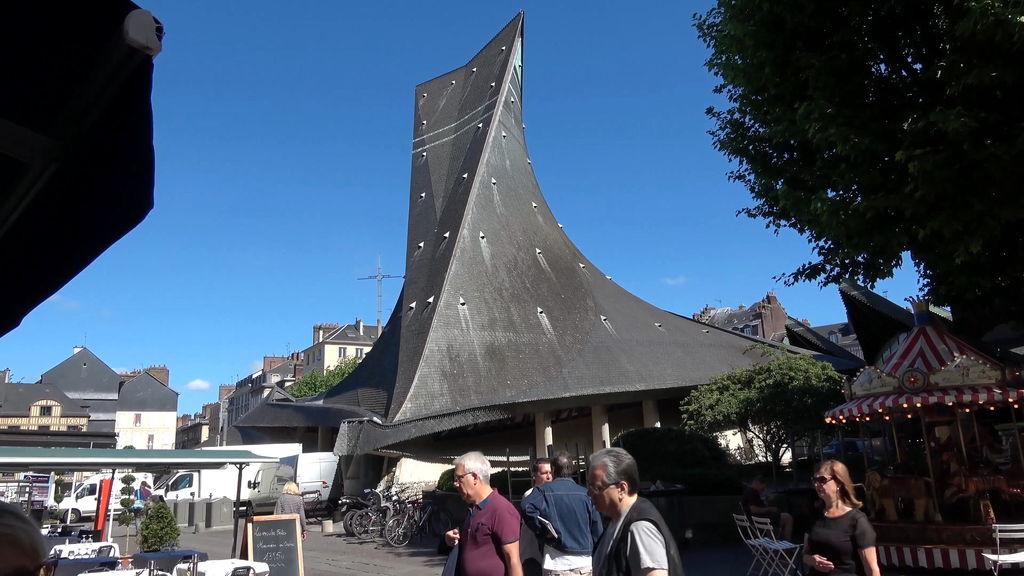
Church of Joan of Arc
An interesting modern church located on the Place du Vieux-Marché. It was here that the national heroine of France was burned at the stake. Therefore, the building has the shape of a bonfire’s flames. Inside the church are stunning Renaissance-era stained glass windows.
Joan of Arc Tower
This is the only surviving part of the medieval castle built by Philip II Augustus in 1207. This large cylindrical tower has three rooms and an attic. Although there is a legend that Joan of Arc was imprisoned in a dungeon here, her cell was actually in another tower of the same castle, which has not survived to this day.
Saint-André Tower
All that remains of the medieval Gothic church of Saint Andrew, built between the 15th and 16th centuries.
Church of Saint-Nicaise
A 16th-century Gothic church. The building was heavily damaged during a fire in 1934, after which it was significantly rebuilt.

Church of Saint-Vivien
A medieval three-nave Gothic church, built in 1358 and expanded in the 15th century. On the north side, a medieval hatch has been preserved, where mothers could leave newborn children to be cared for.
Church of Saint-Godard
A medieval parish church in the style of Flamboyant Gothic and Renaissance. It was built in the 13th century on the site of an older religious structure. The church has a three-nave structure and beautiful stained glass windows from the 16th and 19th centuries.
Saint-Laurent
A beautiful medieval church in the Gothic style, built in the 15th century. The bell tower was added between 1490 and 1501. The church was desecrated during the French Revolution, when it was used for non-religious purposes.
Church of Saint-Éloi
A 16th-century medieval Gothic church, located on Martin Luther King Square. It is a Protestant church.
Video