The medieval walls, towers, and narrow streets of the Upper Town. Find out how to get to Bergamo, where to try ravioli casoncelli, and which nearby villages are worth visiting.
Bergamo City (Italy)
Bergamo (Italian: Bergamo) is a city in Italy, in the Lombardy region, the administrative center of the province of the same name. In post-Soviet countries, the city became very famous thanks to the 1976 film “Truffaldino from Bergamo” with Konstantin Raikin in the lead role. Bergamo is located roughly halfway between Brescia and Milan, about 50 km from the fashion capital.
The population of the city itself is about 120,000 inhabitants, while almost half a million people live in the entire province. It is a very beautiful city with ancient landmarks, architecture, and an interesting history.

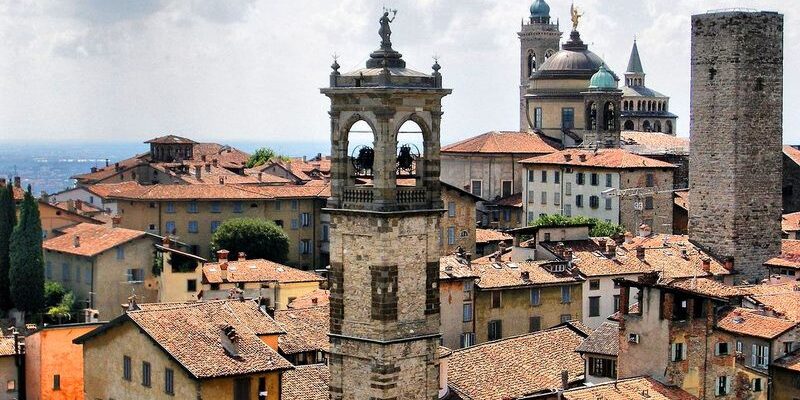
The city of Bergamo is divided into two parts: the “Upper City,” located on a hill and surrounded by walls, and the “Lower City,” which over time merged the surrounding suburbs. The Upper City is the medieval center, surrounded by mighty bastions built in the 16th century during the Venetian rule. It has been preserved almost unchanged. The main attractions are concentrated here. The Lower City is crossed by the Morla River. It was formed from the development of several villages located along the main communication routes and is the complete opposite of the Upper City — wide streets, modern buildings. A modern funicular connects them.

The city stretches across a hilly foothill area. Thanks to the proximity of the mountains, the climate is quite comfortable, although it can be quite hot in summer. Most precipitation falls in spring. Snowfall is possible in winter.
History and Interesting Facts
The city’s history began in 49 BC when the Romans granted the settlement on this site the status of municipium, which is considered the official founding date of Bergamo. After the fall of the Roman Empire, the city was repeatedly sacked. At the end of the 6th century, the Lombards (an ancient Germanic tribe that, in fact, gave this region its name — Lombardy) arrived. Under their rule, the city flourished until it was conquered by the Franks in 774 and given over to the power of the bishops.
The power of the church lasted until 1098. Then Bergamo became a free city, but after several wars with Brescia, it joined the Lombard League. Starting from the 13th century, as part of the struggle between the Guelphs and Ghibellines, Bergamo fell under the influence of Milan.

In 1428, Bergamo became part of the domains of the Venetian Republic. The Venetians reconstructed the Old City, erecting mighty fortress walls. The Venetian domain lasted until the Napoleonic era, when, after a brief period of the Cisalpine Republic and the Kingdom of Italy, Bergamo fell into the sphere of influence of Austria-Hungary. It was the Austrians who started the city’s industrialization.
In 1860, Bergamo became part of unified Italy, where it remains to this day.
Modern Bergamo is an important economic, industrial, and tourist center of Lombardy and Northern Italy.
Hotel Map
How to Get to Bergamo?
The easiest way to get to Bergamo is to fly into its own international airport, Orio al Serio (Milan-Bergamo), which serves many low-cost flights. You can also fly to Milan. The city is located 58 km from Milan, so the bus journey from there will take about an hour. Additionally, you can get there from Turin (190 km, 2-3 hours journey) and Rimini (360 km, 4-5 hours on the road). You can check train schedules and buy tickets on the Trenitalia website.
What to See in Bergamo?
We highly recommend visiting in the “Upper City” the Basilica of Santa Maria Maggiore, the Gates of San Giacomo and Sant’Agostino, the powerful fortifications from the Venetian Republic period, and, of course, the towers. Also, if you have time and opportunity, visit the nearby borghi — picturesque ancient villages, which are among the most beautiful in Italy.
What to Try?
You should definitely try Bergamo cheeses (for example, Stracchino DOP), polenta, sausages, and wines. In restaurants, order delicious local dishes — casoncelli ravioli, hare in wine, Donizetti cake, and scarpinocc de par.
Landmarks and Places of Interest in Bergamo
Bergamo is a city rich in sights: ancient cathedrals, towers, historic squares, and buildings. Most of the attractions are mainly concentrated in the Upper City.
Basilica of Santa Maria Maggiore (Basilica di Santa Maria Maggiore) — one of the main attractions of Bergamo’s “Upper City,” a magnificent basilica founded in the 12th century, whose architecture combines features of Romanesque and Lombard styles. The interior of the basilica is decorated in Baroque style.
Address: Piazza Duomo, 24129 Bergamo BG

Gombito Tower — a landmark of the “Upper City,” a tall square stone tower built in the 12th century. The tower is preserved in excellent condition and has a height of 51.60 m. Originally, the tower height was 64 meters, and it was taller than the Torre Civica, but its height was reduced in the 19th century. The Gombito Tower is built from sandstone blocks in Romanesque style. It forms a single complex with the neighboring building. Initially, the tower served defensive functions, which is why it has so few openings and slits.
Address: Via Mario Lupo, 6, 24129 Bergamo BG
Civic Tower (Torre Civica) — an interesting landmark of Bergamo, a powerful medieval square tower located in the old city center. The tower was built between the 11th and 12th centuries, and it was originally used as a tower house owned by the Suardi family. This was the era when every wealthy family living in the city built towers. The higher the tower building, the more prestige the family had. This is why Bergamo became known as the “city of a hundred towers.”
Later, the tower became the residence of the mayor, and a bell was installed on it.
Initially, the height of Torre Civica was 37 meters, but through constant expansion work already in the Middle Ages, the height reached 56 meters, making the tower the tallest in Bergamo. From the top of Torre Civica, you can enjoy a panorama of the city and picturesque surroundings.
Address: Piazza Vecchia, 8A, 24129 Bergamo BG

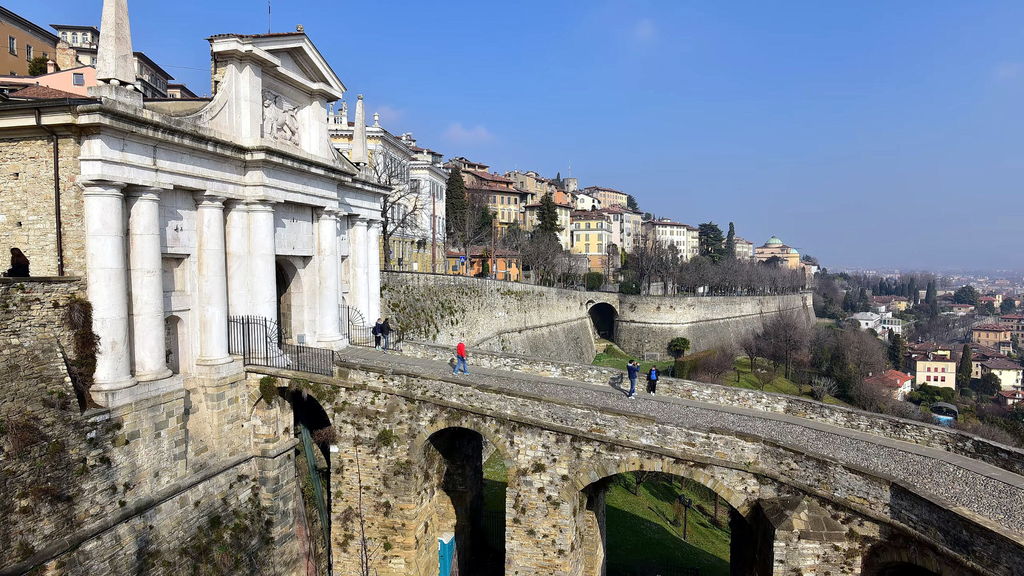
Porta San Giacomo (San Giacomo Gate) — a famous landmark of Bergamo, ancient Venetian gates made of white marble, built in 1592. The gate is one of the four entrances to the Upper City. Until the mid-19th century, Porta San Giacomo closed at 10 p.m., right after the bell on the Torre Civica tolled 100 times.
Address: Viale delle Mura, 24129 Bergamo BG
Colleoni Chapel — a majestic and beautiful landmark, the work of Renaissance master Giovanni Antonio Amadeo. It is located on the cathedral square, leaning against the Basilica of Santa Maria Maggiore. The Colleoni Chapel was built between 1470 and 1476.
Caravaggio (Sanctuary of Santa Maria del Fonte) is located not far from Bergamo. It is one of the most visited and famous sanctuaries in Italy, a place of pilgrimage for a huge number of believers. Works by Juvarra, Cavenaghi, Moriggia, and Cavedoni are preserved here. The building was built over five centuries ago.
Address: Viale Papa Giovanni XXIII, 10, Caravaggio
Sights and Interesting Places Near Bergamo
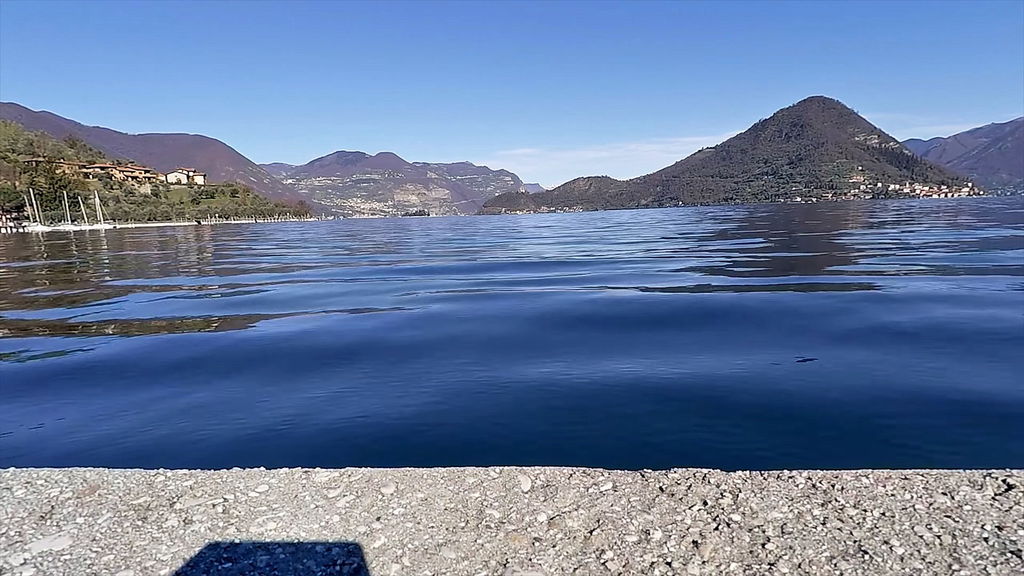
Lake Iseo — a beautiful lake located 180 meters above sea level between Brescia and Bergamo, surrounded by the wonderful nature of low mountain ranges. In the center of the lake rises Monte Isola Island, the largest lake island in Europe, on top of which stands the Rocca Martinengo fortress. Here you can arrange lake cruises, stroll among beautiful natural landscapes, and visit many attractions.
Address: 14 Via Riva Di Solto, Tavernola Bergamasca, BG 24060
Village (Borgo) Gromo — a beautiful borgo located in a picturesque area, on a cliff above the Valle Seriana valley. Gromo is a beautiful village that has been excellently preserved since the Middle Ages. Simple, untreated gray stone prevails on the streets of this ancient town. House roofs are still covered with natural slate (rock slabs), characteristic of the entire mountain area of the province of Bergamo. The buildings are constructed without any excesses and unnecessary decorations – this town was built in an era when one had to work hard, and substance was more important than details. Just a 10-minute drive from Gromo are the ski slopes in Spiazzi di Gromo.

In the center of the village are the old church of San Gregorio and Castello Ginami.
Castello Ginami — built on a rocky cliff in the first half of the 13th century, on the highest part of the territory. It dominates the borgo and its surroundings. Interestingly, its massive towers have remained almost untouched over the centuries. Now the castle houses a quite famous restaurant.
Church of San Gregorio — a stone church located in an ancient 15th-century square.
Address: Piazza Dante Alighieri, 8, 24020 Gromo BG.