

It lives where scuba divers don’t venture and remains a source of scientific debate. Interesting facts about the world’s saddest fish.
Blobfish Description

The blobfish is one of the most mysterious and least studied species of deep-sea ocean dwellers. It belongs to the Psychrolutidae family.
The world learned about the appearance of the blobfish and that such a species even exists about 100 years ago. The first description of the strange creature, caught by Australian fishermen, dates back to 1926.
The first captured specimen was named Psychrolutes marcidus. The mysteries begin with the name itself. It combines two languages. A literal translation would be “a lover of cold baths” (from the Ancient Greek “psychrolutes”) and “feeble” or “withered” (from the Latin “marcidus”). In Russia, this fish is often called the “drop fish,” in Australia it’s the “Australian bullhead,” and in the United Kingdom, it’s the “fathead sculpin” or “toadfish.”
It would seem that almost a century has passed, yet humanity has not solved the mysteries of the blobfish: its specific habitat, the reason for its strange appearance, the extreme depths at which it can reproduce, or the factors influencing mate selection. This is because it lives at great, almost kilometer-deep depths where scuba divers cannot descend.
What the Blobfish Looks Like: Description and Photo

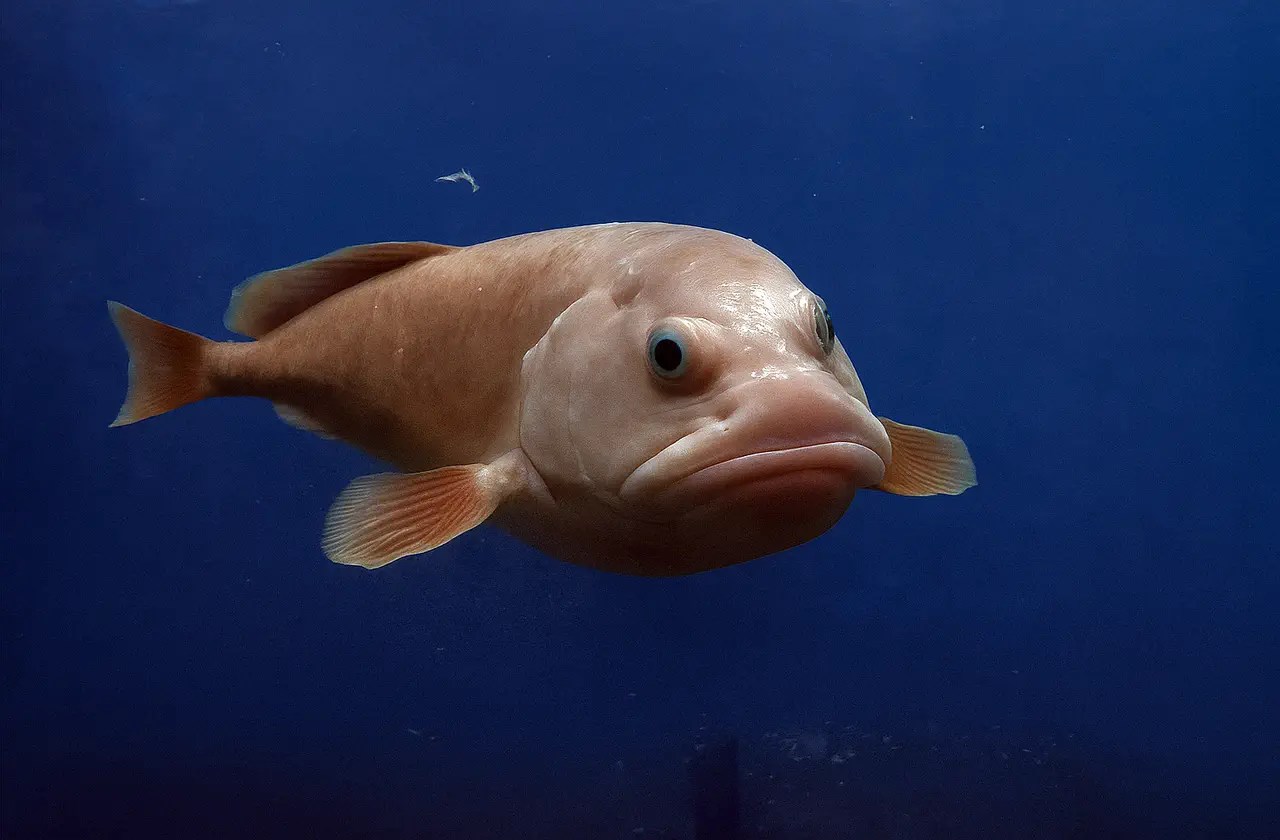
No one is indifferent to the appearance of the blobfish. It’s either “Aww, so squishy!” or “My God, how ugly.” It seems that this creature with its drop-shaped body, huge lips with downturned corners, and an overall gloomy expression isn’t a fish at all. The blobfish lacks scales and strongly resembles a gelatinous mass. Its body has small growths resembling spines, a small tail, and small lateral fins. But all of this is so understated that it’s quite difficult to tell at first glance that you’re looking at a fish.
In the water, Psychrolutes marcidus still resembles its relatives, but when brought to the surface, it begins to “deflate.” The thing is, the blobfish in its natural environment, residing at enormous depths, experiences immense pressure from the water column. It is precisely because of this that it had to evolve in such a unique way. The assumption that, being not very mobile and also lacking protection in the form of scales and sharp teeth, Psychrolutes marcidus preferred to literally lie on the bottom is not without logic.
The blobfish owes its expression of universal sadness to the structure of the front part of its head—its interorbital space is wider than the diameter of its eyes. This creates the impression that it is about to cry. Its face, with a huge nose and small eyes, most closely resembles an offended Moomin troll.
The coloration of this fish species varies widely: from whitish-brown and pink to gray-blue and gray-green. Interestingly, in most specimens, the color saturation is less vibrant in water, and upon interaction with air and light, the coloration becomes more intense. But the opposite also happens. Fishermen joke about this, saying that some blobfish turn pale with fear, while others blush with embarrassment.
This raises a question that greatly interests scientists: why is the color palette of different individuals so diverse? Some argue that it depends on the color of the bottom sediments in the fish’s habitat and that it simply camouflages itself to match them. Others insist that in the darkness of the deep water, colors are impossible to discern anyway. However, young individuals have a lighter coloration that darkens with age.
One way or another, thanks to such an extraordinary appearance, the blobfish, also called the “smooth-head blobfish,” tops the ratings of the strangest creatures on the planet. The online community highly appreciated the blobfish’s unique appearance. Photos of it have spawned countless memes. And the film industry has even made it an actress: the image of the blobfish appears in such cult films as “The X-Files” and “Men in Black.”
How Long Do Blobfish Live?
The blobfish grows quite quickly and lives only 5 to 15 years. It is assumed that subspecies living at greater depths live longer, but there is no reliable scientific confirmation of this yet, and this is a question that remains to be studied.
The body length of the blobfish typically does not exceed 30 centimeters, but larger specimens are found. The weight of the fish can reach 10-12 kilograms. These are relatively small parameters for an inhabitant of the ocean depths.
Where Does the Blobfish Live?

The habitat of this mysterious creature is the deep, cold waters of the Indian, Pacific, and Atlantic Oceans. Most often, the blobfish can be found off the coasts of New Zealand and in the deep waters off the southeastern coast of Australia, near Tasmania. Over the past two decades, blobfish have also been found off the coasts of Japan, Indonesia, and even the northern coast of California.
At the same time, Psychrolutes marcidus is a “homebody” fish; it almost never leaves its settled spots and extremely rarely rises to depths shallower than 600 meters. This means that studying it is quite difficult. Ideally, to shed light on the mysteries of the blobfish, one needs to observe it in its natural habitat. But deep-sea research is expensive, and funds are allocated very reluctantly specifically for studying psychrolutids. It usually appears on camera by accident.
Blobfish: Classification
Due to a number of natural peculiarities, scientists struggled for a long time to classify the blobfish. After lengthy debates, it was decided to consider it a chordate by type, a ray-finned fish by class, belonging to the order Scorpaeniformes, the family Psychrolutidae.
Psychrolutidae, a family of ray-finned fish, is something between lumpfish and sea snails. Many of them have bare skin. There are 11 genera, united into two subfamilies. The closest relatives of blobfish are considered to be cottunculi (Cottunculidae) and soft-tailed sculpins and warty gobies.
Two subspecies of psychrolutids are known: Psychrolutes marcidus, which live at depths of no more than a kilometer, have an average size and low weight, and the inhabitants of kilometer-deep sea depths, Psychrolutes phrictus (the blob sculpin), which can weigh up to 12 or even 14 kilograms.
However, even this classification is not yet definitive. Scientists hope that modern technology will help them learn more about the mysterious fish.
What Does the Blobfish Eat?

Despite its comical appearance, the blobfish is by no means a harmless herbivore. It is a predator, albeit an extremely lazy one and, let’s say, far from meeting physical fitness standards. Its muscles are underdeveloped, and its speed is low.
Therefore, to avoid starving, the psychrolutid simply swims slowly or lies completely still with its mouth open, waiting for small invertebrates and plankton to swim into its mouth on their own.
Lifestyle Features

Another amazing feature of psychrolutids is the absence of a swim bladder. At a depth of 600 meters, the pressure is 60 times greater than at sea level, and at 1200 meters (the maximum depth of the blobfish’s habitat), it is already 120 times higher than at the surface. Naturally, no swim bladder can function normally under such pressure. These gelatinous fish manage to stay afloat without any energy expenditure due to their body mass, the density of which is slightly lower than that of the water in their natural habitat. This is one of the most important conditions for the survival of the entire species.
Psychrolutids are endemic individuals; they are characterized by an attachment to a specific place of residence. The abyss, impenetrable darkness, and complete solitude are the perfect environment for the blobfish’s life.
How the Blobfish Reproduces
After laying eggs, the blobfish does not leave the clutch until the offspring are born
The psychrolutid is also unique in its demographic processes. It can truly be called the best mother among fish. After laying eggs, it does not leave the clutch until the offspring are born.
Later, the wonder-fish mother continues to care for her offspring. The family stays together until the fry grow up, adapt, and gain independence.
It is still unknown exactly how the mating ritual occurs in psychrolutids, or if there even is one, how they find a partner, or how they prepare for spawning. For now, scientists agree that blobfish interrupt their solitude only for procreation.
Natural Enemies
With the development of deep-sea fishing, psychrolutids have increasingly been caught in trawl nets, putting the species at risk of extinction
As for enemies, the psychrolutid has practically none in the water. Its secretive lifestyle, excellent camouflage, and slowness, which does not attract attention, make it almost invulnerable. Only if it accidentally catches the eye of a rare deep-sea predator—a giant squid or an anglerfish. The only real threat to it is the most terrible and merciless creature—humans, who have learned to bring fish up from the greatest depths to the surface.
With the development of deep-sea fishing, psychrolutids have increasingly been caught in trawl nets, putting the species at risk of extinction. Moreover, no one specifically hunts them; they are caught accidentally, along with squid and lobsters.
As a food product, the blobfish, although not poisonous, is of rather dubious gastronomic interest. Their tasteless, gelatinous, fatty mass is consumed as food only by lovers of exoticism and residents of Asian countries, seasoned with a huge amount of spices.
Population and Conservation Status

The reason fishermen don’t release accidentally caught psychrolutids is again their amazing appearance. They are sold as curiosities, but more often used simply for advertising. A stall featuring a blobfish invariably attracts attention, increasing the vendor’s revenue.
For a deep-sea dweller, rising to the surface and, accordingly, the change in pressure is fatal. The psychrolutid dies within minutes, after which its body is processed and sold to tourists as a souvenir.
It is not possible to calculate even the approximate number of individuals of this secretive fish species. The population recovers very slowly; it would take more than ten years to double the numbers.
No less a threat to the populations of not only these fish but also other deep-sea inhabitants is the garbage that continuously accumulates on the bottom, releasing harmful toxins and poisoning the world’s oceans.
Currently, a united community of scientists—ecologists, biologists, oceanographers—as well as citizen initiative groups are trying to achieve the assignment of “endangered species” status for Psychrolutes marcidus.
However, this status has not yet been officially endorsed by representatives of all the countries in whose waters the unusual fish resides. We can only hope that the psychrolutids will not become extinct and that their mysteries will not disappear into the watery depths.


