<div class="table-of-contents open"><!--noindex--><div class="table-of-contents__header"><span class="table-of-contents__hide js-table-of-contents-hide">Contents</span></div><ol class="table-of-contents__list js-table-of-contents-list">
<li class="level-1"><a href="#a-cat-s-sense-of-smell-features-and-anatomy">A cat’s sense of smell: features and anatomy</a></li><li class="level-2"><a href="#how-a-cat-s-nose-works">How a cat’s nose works</a></li><li class="level-1"><a href="#smells-that-cats-and-kittens-hate">Smells that cats and kittens hate</a></li></ol><!--/noindex--></div><h4 class="ds-markdown-paragraph"><span class="">Why you shouldn’t peel oranges and onions around cats</span></h4>
<p class="ds-markdown-paragraph"><span class="">If you live with a cat, you’ve probably noticed how your fluffy companion reacts differently to smells. One moment they’re enthusiastically sniffing socks or the trash bin, and the next they bolt, having caught a whiff of your favorite perfume. Why does this happen?</span></p>
<h2 class="ds-markdown-paragraph" id="a-cat-s-sense-of-smell-features-and-anatomy"><span class="">A cat’s sense of smell: features and anatomy</span></h2>
<figure id="attachment_27486" aria-describedby="caption-attachment-27486" style="width: 750px" class="wp-caption aligncenter"><a href="https://mandry.club/wp-content/uploads/2026/05/A-cats-sense-of-smell02.webp"><img class="wp-image-27486 size-medium" src="https://mandry.club/wp-content/uploads/2026/05/A-cats-sense-of-smell02-750x424.webp" alt="Cat olfactory system anatomy and smelling pheromones over long distances" width="750" height="424" /></a><figcaption id="caption-attachment-27486" class="wp-caption-text">Cats can detect pheromones released to attract a mate from a great distance</figcaption></figure>
<p class="ds-markdown-paragraph"><span class="">A cat’s sense of smell plays a vital role from day one. After all, kittens are born blind and deaf. It’s only through their ability to perceive and distinguish scents that they can recognize their mother.</span><br />
<span class="">As they age, smell doesn’t lose its significance.</span></p>
<ul>
<li>
<p class="ds-markdown-paragraph"><strong><span class="">Ensures safety.</span></strong><span class=""> By smell, cats can identify inedible food and changes in their environment.</span></p>
</li>
<li>
<p class="ds-markdown-paragraph"><strong><span class="">Helps communication and spatial orientation.</span></strong><span class=""> This is why cats sniff each other when they meet and leave scent marks on their territory and on people.</span></p>
</li>
<li>
<p class="ds-markdown-paragraph"><strong><span class="">Plays a role in reproduction.</span></strong><span class=""> Cats can detect pheromones released to attract a mate from a great distance.</span></p>
</li>
</ul>
<h3 class="ds-markdown-paragraph" id="how-a-cat-s-nose-works"><strong><span class="">How a cat’s nose works</span></strong></h3>
<figure id="attachment_27484" aria-describedby="caption-attachment-27484" style="width: 750px" class="wp-caption aligncenter"><a href="https://mandry.club/wp-content/uploads/2026/05/A-cats-sense-of-smell05.webp"><img class="wp-image-27484 size-medium" src="https://mandry.club/wp-content/uploads/2026/05/A-cats-sense-of-smell05-750x424.webp" alt="Close-up of cat nose structure with unique nose print similar to human fingerprint" width="750" height="424" /></a><figcaption id="caption-attachment-27484" class="wp-caption-text">In China, one insurance company offered pet owners the option to insure their pets using nose prints, which, like human fingerprints, are unique</figcaption></figure>
<p class="ds-markdown-paragraph"><span class="">The primary olfactory organ in cats is the nose. Here’s a breakdown of its components.</span></p>
<ul>
<li>
<p class="ds-markdown-paragraph"><strong><span class="">Nose leather.</span></strong><span class=""> The soft external part of the nose serves a protective function and plays a role in thermoregulation. Interesting fact: a cat’s nose print is just as unique as a human fingerprint. Because of this, an insurance company in China once offered pet owners the option to insure their companions using nose prints.</span></p>
</li>
<li>
<p class="ds-markdown-paragraph"><strong><span class="">Nostrils.</span></strong><span class=""> These are the openings needed to inhale air.</span></p>
</li>
<li>
<p class="ds-markdown-paragraph"><strong><span class="">Nasal passages and internal nostrils (choanae).</span></strong><span class=""> Air travels through these to reach the respiratory organs.</span></p>
</li>
<li>
<p class="ds-markdown-paragraph"><strong><span class="">Labyrinth of ethmoid turbinates.</span></strong><span class=""> Thanks to these, scent-laden air reaches the cat’s olfactory receptors.</span></p>
</li>
</ul>
<p class="ds-markdown-paragraph"><span class="">Besides the nose, cats have an additional olfactory organ — the Jacobson’s organ. It’s located behind the front teeth. Scientists still haven’t reached a consensus on its exact purpose. The main hypotheses are:</span></p>
<ul>
<li>
<p class="ds-markdown-paragraph"><span class="">more precise recognition of food smells;</span></p>
</li>
<li>
<p class="ds-markdown-paragraph"><span class="">monitoring the chemical composition of the air to predict disasters;</span></p>
</li>
<li>
<p class="ds-markdown-paragraph"><span class="">detecting pheromones and other “social” scents.</span></p>
</li>
</ul>
<h2 class="ds-markdown-paragraph" id="smells-that-cats-and-kittens-hate"><strong><span class="">Smells that cats and kittens hate</span></strong></h2>
<figure id="attachment_27488" aria-describedby="caption-attachment-27488" style="width: 750px" class="wp-caption aligncenter"><a href="https://mandry.club/wp-content/uploads/2026/05/A-cats-sense-of-smell04.webp"><img class="wp-image-27488 size-medium" src="https://mandry.club/wp-content/uploads/2026/05/A-cats-sense-of-smell04-750x424.webp" alt="Cat reacting with disgust to lemon and mandarin citrus fruit scents" width="750" height="424" /></a><figcaption id="caption-attachment-27488" class="wp-caption-text">Cats equally dislike the smell of lemon and mandarin</figcaption></figure>
<p class="ds-markdown-paragraph"><span class="">It’s believed that a cat’s sense of smell is about fourteen times stronger than a human’s. That’s why they often dislike scents that seem pleasant to us.</span></p>
<ul>
<li>
<p class="ds-markdown-paragraph"><strong><span class="">Citrus fruits.</span></strong><span class=""> When peeling an orange or mandarin, fluffy companions usually wrinkle their noses, snort, and run away. There are almost no exceptions. Cats equally dislike the smell of lemon and mandarin. The reaction to the fruit’s flesh, however, isn’t as strong as it is to the peel. This is because citrus zest contains a large amount of essential oils, which greatly irritate a sensitive feline nose. If a cat doesn’t react to this smell, it’s worth paying attention: perhaps your pet has caught a cold and simply can’t smell it.</span></p>
</li>
<li>
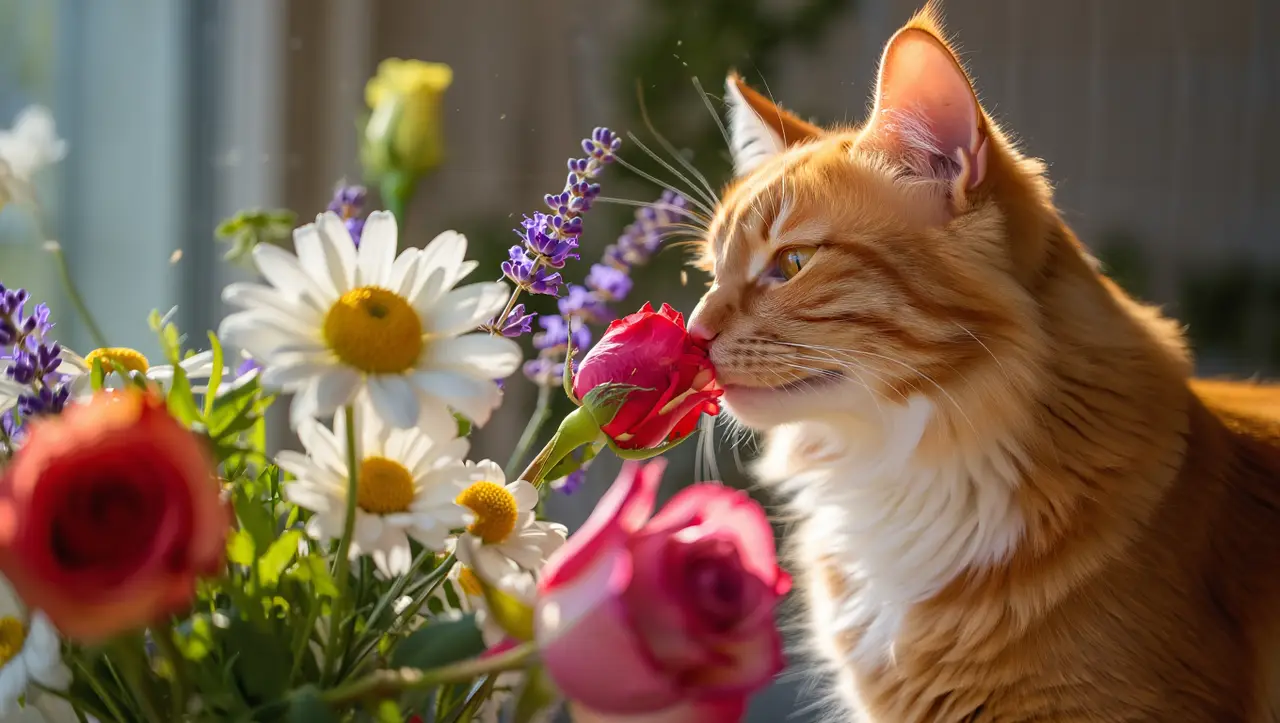
<p class="ds-markdown-paragraph"><strong><span class="">Essential oils.</span></strong><span class=""> Often, aversion to certain smells is a protective reaction. Cats can’t stand the scent of essential oils because they can be toxic. A cat’s liver cannot produce the enzymes needed to process these chemicals. The most dangerous oils include: pine, eucalyptus, clove, tea tree, citrus, ylang-ylang, cinnamon, wintergreen, and pennyroyal. The main signs of poisoning are difficulty breathing, excessive salivation, muscle tremors, lowered body temperature, and a decreased pulse rate.</span></p>
</li>
<li>
<p class="ds-markdown-paragraph"><strong><span class="">Plants.</span></strong><span class=""> Cats dislike the smells of only certain plants. Examples include lavender, geranium, mint, eucalyptus, and rosemary. These plants release phytoncides, which irritate the mucous membranes of the animal’s respiratory tract. And conversely: in nature, there are plants whose scents attract cats, such as valerian and honeysuckle.</span></p>
</li>
<li>
<p class="ds-markdown-paragraph"><strong><span class="">Bananas.</span></strong><span class=""> This might seem strange to people, but cats hate the smell of bananas, especially very ripe ones. The reason is that banana peels contain a substance whose odor closely resembles acetone. Humans can’t detect it, but it’s no coincidence that a cat’s nose is stronger!</span></p>
</li>
<li>
<p class="ds-markdown-paragraph"><strong><span class="">Onions and garlic.</span></strong><span class=""> The pungent smell of onions and garlic affects a cat much the same way it affects a human. Only cats don’t cry — they blink. The culprit is the phytoncides contained in onions, which irritate the mucous membranes of the nose, mouth, and eyes.</span></p>
<p><figure id="attachment_27487" aria-describedby="caption-attachment-27487" style="width: 750px" class="wp-caption aligncenter"><a href="https://mandry.club/wp-content/uploads/2026/05/A-cats-sense-of-smell03.webp"><img class="wp-image-27487 size-medium" src="https://mandry.club/wp-content/uploads/2026/05/A-cats-sense-of-smell03-750x424.webp" alt="Cat blinking from irritation caused by onion smell while owner cuts vegetables" width="750" height="424" /></a><figcaption id="caption-attachment-27487" class="wp-caption-text">Cats don’t cry from onion smells — they blink</figcaption></figure></li>
<li>
<p class="ds-markdown-paragraph"><strong><span class="">Spices and seasonings.</span></strong><span class=""> The smell of black and red pepper, cinnamon, cloves, ginger, and other spices is unpleasant to cats for the same reason: they contain phytoncides that irritate mucous membranes.</span></p>
</li>
<li>
<p class="ds-markdown-paragraph"><strong><span class="">Coffee.</span></strong><span class=""> Cats dislike the smell of both coffee beans and ground coffee. The reason is organic compounds that are toxic to these animals.</span></p>
</li>
<li>
<p class="ds-markdown-paragraph"><strong><span class="">Vinegar.</span></strong><span class=""> The sharp smell of vinegar bothers them because of the acetic acid, which in its pure form is dangerous not only for cats but also for people. Animals can’t tolerate even the weak concentration of acid found in common table vinegar.</span></p>
</li>
<li>
<p class="ds-markdown-paragraph"><strong><span class="">Alcohol.</span></strong><span class=""> Cats dislike the smell of alcohol in any liquid — be it perfume or spirits. Alcohol evaporates quickly, so when inhaled it can injure mucous membranes and reduce olfactory sensitivity.</span></p>
</li>
<li>
<p class="ds-markdown-paragraph"><strong><span class="">Tobacco.</span></strong><span class=""> This applies not only to the smell of tobacco smoke while smoking but also to the plant itself. The smoke is toxic to cats and can cause asthma and other lung diseases.</span></p>
</li>
<li>
<p class="ds-markdown-paragraph"><strong><span class="">Household chemicals and petroleum products.</span></strong><span class=""> Cats’ aversion to these smells is tied to a protective reaction. Many chemicals in such products are harmful to animal health. Inhaling them can lead to allergies, poisoning, and respiratory tract burns.</span></p>
</li>
</ul>
<p class="ds-markdown-paragraph"><span class="">Of course, there are always exceptions. In the world, there are cats that eat citrus, sniff geraniums, and stroll calmly through lavender fields. Reactions to different smells can be highly individual. But scents absolutely affect the lives and health of cats. That’s why it’s better to protect your companions from aromas they might not enjoy.</span></p>
We'll explain what stars are, how they shine, and why we can't see them during…
A well-packed suitcase is one of the key ingredients for a successful trip. Taking everything…
By Tony Wooding People often ask me what my dream holiday is. Most expect the…
The hospitality industry in Turkey is one of the best in the world. And this…
The majority of hotels worldwide are geared toward family vacations: they offer entertainment for children,…
Is there salt in raindrops, why do the seas remain salty if so many freshwater…
