<p class="ds-markdown-paragraph"><span class="">Is there salt in raindrops, why do the seas remain salty if so many freshwater rivers flow into them — an oceanologist answered these and other questions for us.</span></p>
<p class="ds-markdown-paragraph"><span class="">Answered by </span><span class="">an oceanologist, engineer of the Polar Marine Geological Exploration Expedition group</span></p>
<p class="ds-markdown-paragraph"><span class="">First, I will explain which water is considered salty and which is fresh. The salt content in water is measured in per mille (‰). For example, in the saltiest place on the planet, the Dead Sea, salinity ranges from 300 to 350‰, meaning 300–350 g of salt are dissolved in one liter of water. Water whose salinity does not exceed 1‰ is considered fresh. The international standard for calibrating instruments is &#8220;normal water&#8221; with a salinity of about 35‰. For example: the Atlantic Ocean — 35.4‰, the Pacific Ocean — 34.5‰, the Red Sea — 41‰, the Mediterranean Sea — 39‰, the Black Sea — 18‰ (on the surface), the Sea of Azov — 11‰.</span></p>
<p class="ds-markdown-paragraph"><span class=""><a href="https://mandry.club/en/interesting-facts/what-does-the-sea-consist-of/">Why is the sea salty</a>? There is a main version. It is believed that during the period of the earth&#8217;s crust formation, increased <a href="https://mandry.club/en/interesting-facts/12-highest-and-active-volcanoes/">volcanic</a> activity was observed. Gases containing vapors of chlorine, bromine, and fluorine reacted with water to form acids. The acids entered into a chemical reaction with the solid rocks of the ocean floor, resulting in the formation of salts. Over hundreds of millions of years, the composition of the water gradually approached the modern one — it became relatively salty.</span></p>
<p><a href="https://mandry.club/wp-content/uploads/2026/06/River-meets-sea-II_01.webp"><img class="aligncenter size-medium wp-image-27927" src="https://mandry.club/wp-content/uploads/2026/06/River-meets-sea-II_01-750x428.webp" alt="Why sea water is salty oceanology explanation" width="750" height="428" /></a></p>
<pre><code class="language-html"></code></pre>
<p class="ds-markdown-paragraph"><span class="">And of course, a small amount of salts enters the seas through rivers.</span></p>
<p class="ds-markdown-paragraph"><span class="">The main reason why river water is fresh is atmospheric precipitation, which contains very few salts. This is facilitated by the water cycle in nature, which has been going on for millions of years.</span></p>
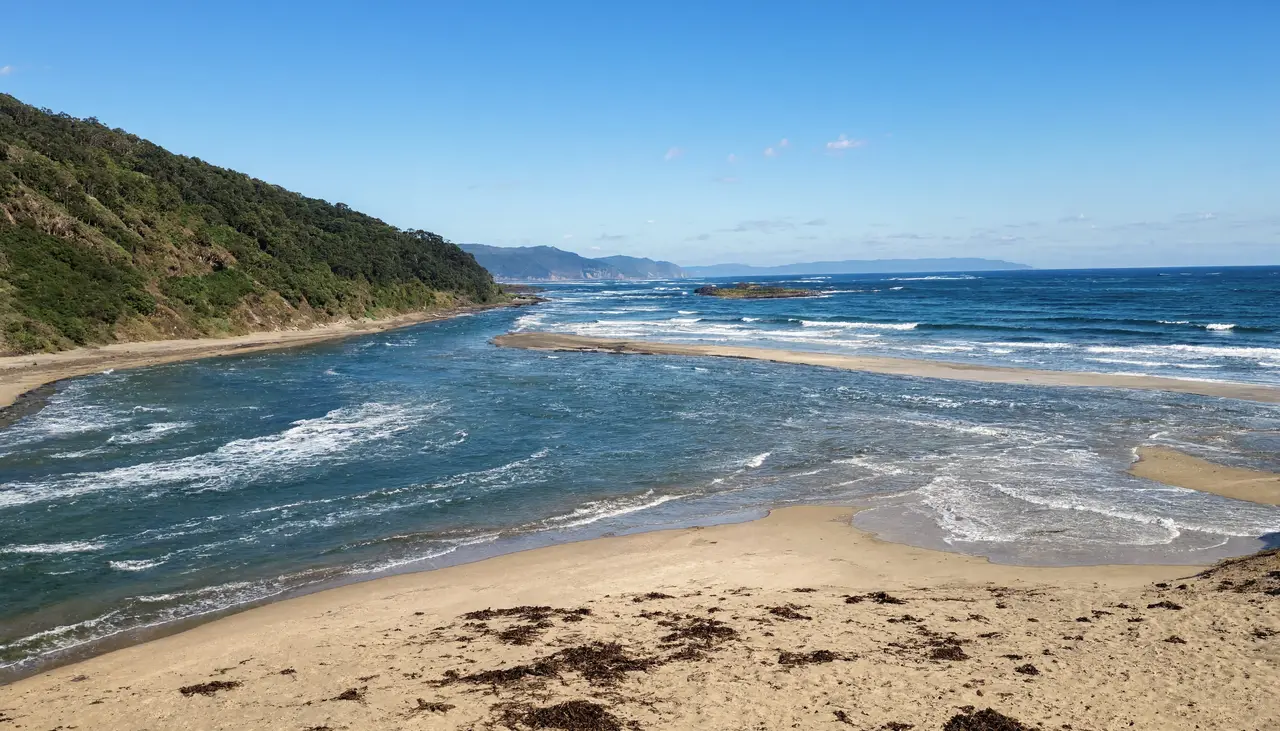
<p class="ds-markdown-paragraph"><span class="">On its way, rain mixes with dust, washes away various deposits from surfaces, and contacts various minerals as it seeps deep into the earth. As a result, the water is enriched with all kinds of impurities, including salts. Streams and trickles of water enter the river, and it carries its waters into the seas (in coastal areas, river water somewhat freshens the sea water). Under the influence of the sun, water evaporates from the surface of the world ocean, while the salt remains. Atmospheric water in the form of precipitation, containing almost no salt, pours onto the continents again.</span></p>
<blockquote class="info"><p>On the continents, precipitation has been forming mountain glaciers for centuries, where some rivers originate.</p></blockquote>
<pre><code class="language-html"></code></pre>
<p class="ds-markdown-paragraph"><span class="">Precipitation feeds the ground and surface waters of the earth. Springs, lakes, and swamps are the places where another part of the planet&#8217;s rivers originate. If a stream does contain various dissolved salts or something has seeped or fallen into the river, then, firstly, it is in small quantities, and secondly, the current gradually carries everything towards the sea, and the concentration decreases along the way. And in the sea-ocean, water evaporates from the surface, salt remains, and the cycle repeats.</span></p>
<!-- toc empty -->
We'll explain what stars are, how they shine, and why we can't see them during…
A well-packed suitcase is one of the key ingredients for a successful trip. Taking everything…
By Tony Wooding People often ask me what my dream holiday is. Most expect the…
The hospitality industry in Turkey is one of the best in the world. And this…
The majority of hotels worldwide are geared toward family vacations: they offer entertainment for children,…
Lake Van (Turkey) is the country’s largest and one of its most mysterious lakes, with…
