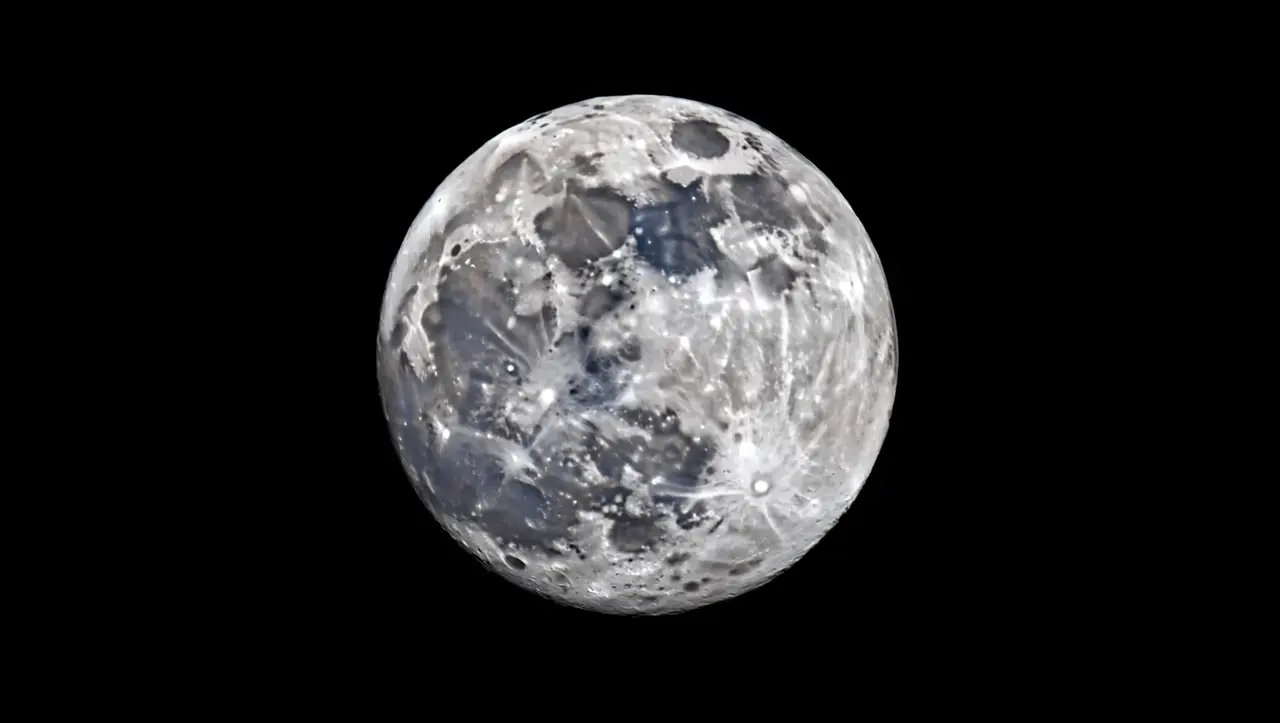
<p>What would life on our planet look like and would it exist at all? We explain.</p>
<p>A glance at the night sky reveals a silver disc that seems like a simple ornament. In reality, this satellite keeps the planet in balance. Without the Moon, geology, biology, climate, and even human culture would be entirely different.</p>
<div class="table-of-contents open"><!--noindex--><div class="table-of-contents__header"><span class="table-of-contents__hide js-table-of-contents-hide">Contents</span></div><ol class="table-of-contents__list js-table-of-contents-list">
<li class="level-1"><a href="#atmosphere">Atmosphere</a></li><li class="level-1"><a href="#possible-absence-of-life">Possible Absence of Life</a></li><li class="level-1"><a href="#short-days-and-extreme-weather">Short Days and Extreme Weather</a></li><li class="level-1"><a href="#a-silent-sky">A Silent Sky</a></li></ol><!--/noindex--></div><h2 id="atmosphere">Atmosphere</h2>
<figure id="attachment_27579" aria-describedby="caption-attachment-27579" style="width: 750px" class="wp-caption aligncenter"><a href="https://mandry.club/wp-content/uploads/2026/05/Luminous-Full-Moon_02.webp"><img class="size-medium wp-image-27579" src="https://mandry.club/wp-content/uploads/2026/05/Luminous-Full-Moon_02-750x424.webp" alt="Full Moon shining in the night sky above Earth's atmosphere" width="750" height="424" /></a><figcaption id="caption-attachment-27579" class="wp-caption-text">Geophysicists call the Moon a &#8220;satellite of life,&#8221; emphasizing that without it, the magnetic field would never have become so strong.</figcaption></figure>
<p>Scientists believe the Moon was born from a catastrophe: early Earth collided with a Mars-sized object called Theia. If this impact hadn&#8217;t occurred, the Moon wouldn&#8217;t exist.</p>
<p>The collision itself remelted both worlds. Earth, being larger, attracted most of Theia&#8217;s iron and heavy elements. This is how the planet acquired an enlarged iron core. And a large core generates a powerful magnetic field. This field protects Earth from the Sun&#8217;s radiation attacks.</p>
<p>Without such protection, the atmosphere would constantly lose particles under the onslaught of solar wind, and the very first life forms, had they even been able to appear, would have evolved completely differently. Geophysicists call the Moon a &#8220;satellite of life,&#8221; emphasizing that without it, the magnetic field would never have become so strong.</p>
<h2 id="possible-absence-of-life">Possible Absence of Life</h2>
<figure id="attachment_27577" aria-describedby="caption-attachment-27577" style="width: 750px" class="wp-caption aligncenter"><a href="https://mandry.club/wp-content/uploads/2026/05/Moon-and-Milky-Way_04.webp"><img class="size-medium wp-image-27577" src="https://mandry.club/wp-content/uploads/2026/05/Moon-and-Milky-Way_04-750x424.webp" alt="Moon illuminating a calm ocean surface vital for early life evolution" width="750" height="424" /></a><figcaption id="caption-attachment-27577" class="wp-caption-text">Without lunar gravity, oceans would remain almost motionless. Stagnant water doesn&#8217;t mix substances, meaning biomolecules would evolve immeasurably slower, and life might never have begun.</figcaption></figure>
<p>Over 3 billion years ago, oceans appeared on Earth, mixing chemicals and distributing them across the planet. This giant &#8220;mixer&#8221; accelerated the formation of increasingly complex organic molecules, until some of them became capable of self-replication. It was in this chaotic and unstable environment that the first living cells emerged.</p>
<p>Without lunar gravity, oceans would remain almost motionless. Stagnant water doesn&#8217;t mix substances, meaning biomolecules would evolve immeasurably slower, and life might never have begun.</p>
<h2 id="short-days-and-extreme-weather">Short Days and Extreme Weather</h2>
<figure id="attachment_27578" aria-describedby="caption-attachment-27578" style="width: 750px" class="wp-caption aligncenter"><a href="https://mandry.club/wp-content/uploads/2026/05/Harvest-Moon_01.webp"><img class="size-medium wp-image-27578" src="https://mandry.club/wp-content/uploads/2026/05/Harvest-Moon_01-750x424.webp" alt="Orange Harvest Moon over a turbulent ocean representing chaotic climate conditions" width="750" height="424" /></a><figcaption id="caption-attachment-27578" class="wp-caption-text">Seasons would change chaotically. The equator would heat up to extraordinary temperatures, and the poles would plunge into a half-year icy night.</figcaption></figure>
<p>Even today, the Moon influences the ocean: friction occurs between water and the seabed, which gradually slows Earth&#8217;s rotation. Currently, the day lengthens by about 1.7 milliseconds every century, and over billions of years this effect has stretched the day to the familiar 24 hours. Without the Moon, days would be much shorter — just six to ten hours. The planet would race at a frantic pace, generating hurricane-force winds. But the main danger isn&#8217;t the length of the day.</p>
<p>Lunar gravity keeps Earth&#8217;s rotation axis from strong oscillations. Without this stabilizer, the axis would wobble from side to side. The gravitational influence of other planets would change the tilt of Earth&#8217;s axis over a wide range — from 0° to 85° instead of the current stable 23.5°.</p>
<p>Seasons would change chaotically. The equator would heat up incredibly, and the poles would plunge into a half-year icy night. Plants, being more resilient, might perhaps adapt to radiation and temperature swings, but animals — unlikely. A Moonless Earth could remain lush and green, but without bird chirps and wolf howls. And at night, darkness would reign on the planet, threatening extinction for all species accustomed to hunting and reproducing under starlight.</p>
<h2 id="a-silent-sky">A Silent Sky</h2>
<figure id="attachment_27581" aria-describedby="caption-attachment-27581" style="width: 750px" class="wp-caption aligncenter"><a href="https://mandry.club/wp-content/uploads/2026/05/Crescent-Glow.webp"><img class="wp-image-27581 size-medium" src="https://mandry.club/wp-content/uploads/2026/05/Crescent-Glow-750x424.webp" alt="Crescent Moon glowing faintly over Earth symbolizing silent night sky" width="750" height="424" /></a><figcaption id="caption-attachment-27581" class="wp-caption-text">Without the Moon, neither the lunar calendar nor the first astronomical records would have emerged.</figcaption></figure>
<p>The harm from the Moon&#8217;s absence would be felt even at the single-cell level. The Moon&#8217;s tidal forces not only rock the ocean but also constantly &#8220;squeeze and release&#8221; Earth&#8217;s core, generating heat. Without this mechanical influence, the planet&#8217;s internal dynamo would work weaker, directly affecting plate tectonics and volcanic activity. But that&#8217;s not all.</p>
<p>Let&#8217;s suppose humanity did appear on such a planet. But at night, there would be no Moon above people. Only distant planets and the starry realm of the Milky Way. Archaeologists find evidence that already 20,000 years ago, people carefully monitored lunar cycles. Ancient farmers created calendars whose structure was directly determined by solar and lunar cycles. Without the Moon, neither the lunar calendar nor the first astronomical records would have emerged.</p>
<p>Our nearest neighbor in the sky awakened curiosity in humans. Humans began to wonder how to fly to the Moon, and what secrets the Universe hides. Without the Moon, this impetus might not have happened. The space exploration program would look different. And perhaps humanity would have remained a purely terrestrial species, never taking a step toward the stars.</p>
<p>Also on this topic:</p>
<ul>
<li><a href="https://mandry.club/en/useful-information/the-moon-illusion-why-it-looks-bigger-on-the-horizon/">Why is the Moon sometimes big and sometimes small?</a></li>
<li><a href="https://mandry.club/en/interesting-facts/five-myths-about-the-moon/">Five myths about the Moon</a></li>
<li><a href="https://mandry.club/en/interesting-facts/the-magic-of-eclipses/">What we don&#8217;t know about eclipses</a></li>
</ul>
We'll explain what stars are, how they shine, and why we can't see them during…
A well-packed suitcase is one of the key ingredients for a successful trip. Taking everything…
By Tony Wooding People often ask me what my dream holiday is. Most expect the…
The hospitality industry in Turkey is one of the best in the world. And this…
The majority of hotels worldwide are geared toward family vacations: they offer entertainment for children,…
Is there salt in raindrops, why do the seas remain salty if so many freshwater…
