Discover the main landmarks of the republic with descriptions, travel guides, and maps.
The Republic of San Marino
San Marino (Italian: Serenissima Repubblica di San Marino) is a microstate in Southern Europe. Located in the northeastern part of the Apennine Peninsula, just 10 km from Rimini, it is entirely surrounded by Italy. San Marino is the oldest republic in the world and one of the smallest countries, covering just over 60 square kilometers. Despite its size, it is an incredibly fascinating destination. The historic center, perched on Mount Titano, is a UNESCO World Heritage Site, preserving medieval architecture, ancient fortress walls, and a unique atmosphere.
Geography and Climate
San Marino is situated in the northeastern Apennine Peninsula near the Adriatic Sea. The republic occupies the slopes of Mount Titano (which is technically a high hill) and its foothills. The climate is subtropical Mediterranean, with warm but not excessively hot summers and mild, though cooler than coastal areas, winters.

Practical Information
- Population: 33.5 thousand
- Area: 61.2 square kilometers
- Official language: Italian
- Currency: Euro (€)
- Visa: Schengen visa required
- Time zone: Central European Time (UTC +1, +2 in summer)
- Religion: Catholicism
Best Time to Visit
The best time to visit San Marino is late spring (April-May) or early autumn (September-October). During these periods, the weather is pleasant without extreme heat, and tourist crowds are smaller than in peak summer.

Advantages of visiting in spring/autumn:
- Comfortable temperatures (15-25 °C)
- Fewer tourists
- Lower accommodation prices
- Beautiful scenery (spring blossoms or autumn foliage)
Summer months (June-August) also attract many visitors, though temperatures can reach 25-30 °C, and crowds increase.
Winter (December-February) is the least popular season, but for those who don’t mind cooler weather (0-10 °C), it offers nearly empty streets and charming Christmas markets.
History
According to legend, San Marino was founded in 301 AD by a stonemason named Marinus and his followers. Fleeing persecution from the island of Rab (modern-day Croatia), Marinus found refuge on Mount Titano, where he established a quarry and built a small hermitage. His pious life attracted pilgrims, and a monastery named after Saint Marinus was founded.

The monastery on Mount Titano has been documented since the 6th century. It maintained self-governance, and San Marino gained de facto independence in 855. The republic is led by two Captains Regent, elected every six months. San Marino is considered the world’s oldest surviving republic and one of the planet’s oldest sovereign states. Throughout its history, it has avoided conflicts and maintained peaceful neutrality.
On October 8, 1600, San Marino adopted its constitution. Remarkably, it retained independence during the Napoleonic Wars and was recognized by Giuseppe Garibaldi during Italy’s unification in the 19th century. During World War I, it joined the Allies, and in World War II, it remained neutral, though it briefly cooperated with Italian fascists and was occupied by German troops.

How to Get There
The nearest airport and train station are in Rimini, Italy. Other options include Bologna and Ancona airports. The Bonelli Bus 72 runs daily from Rimini to San Marino with regular intervals. Tickets can be purchased from the driver or at the tourist information center.
Shopping
San Marino is a great shopping destination for clothing, footwear, perfumes, cosmetics, electronics, and musical instruments. A major advantage is the absence of VAT on goods.
Shopping centers:
- Big & Chic – Via Strada dei Censiti, 1 – 47891 Rovereta
- Azzurro – Via M. Moretti, 23 – 47899 Serravalle
- Atlante – Via Tre Settembre, 17
Cuisine
San Marino’s cuisine reflects the Emilia-Romagna region: tortellini, lasagna, spaghetti Bolognese, passatelli, prosciutto, various cheeses, cappelletti, and pizza.
Landmarks

The historic heart of the republic lies on Mount Titano, where the capital—also named San Marino—is located. This medieval city covers 7.09 square kilometers at an elevation of over 700 meters, featuring ancient streets, stone buildings, fortress walls, and iconic landmarks.
The historic center was originally fortified with three rings of walls, built in different periods and partially demolished to allow urban expansion.

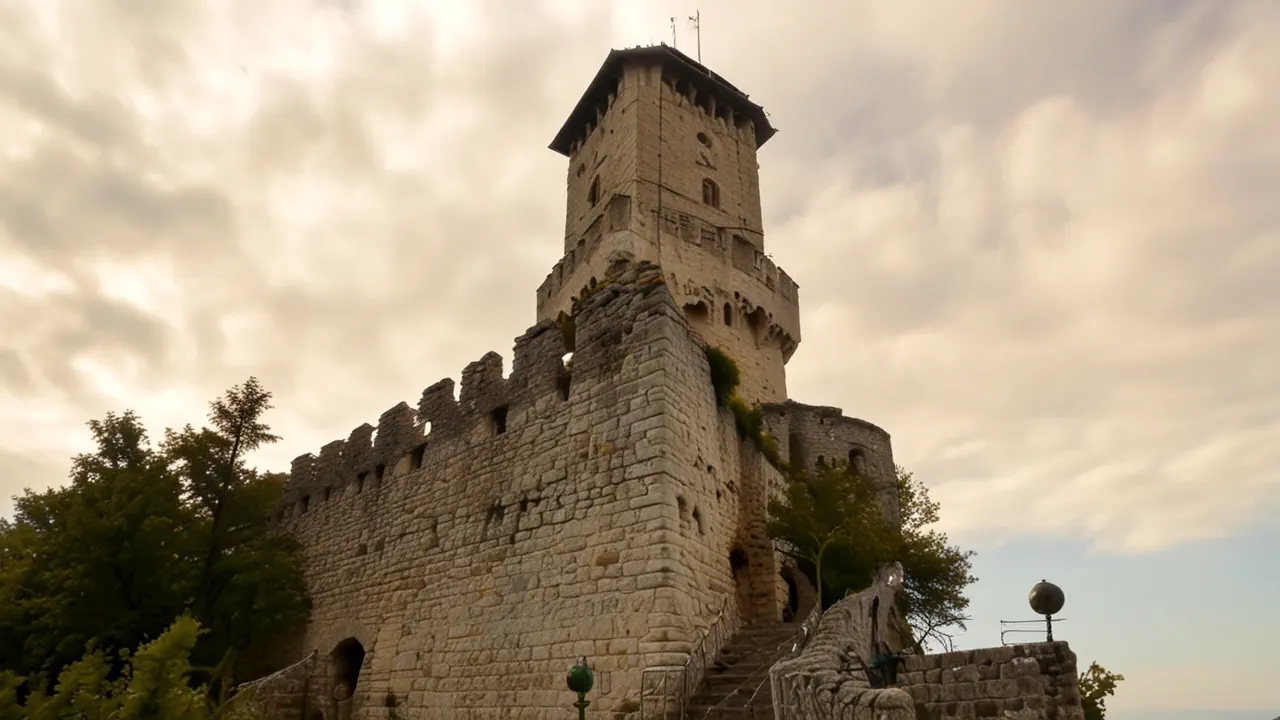
The most iconic landmarks are the three medieval towers, symbols of the republic’s freedom and independence:
- Guaita (First Tower): Built in the 10th century on a rocky base without a foundation, reinforced in the 15th–16th centuries, with fortified walls and a Baroque stone crest.

- Cesta (Second Tower): Stands on the highest peak of Mount Titano (11th century), once a watchtower and prison, now housing the Museum of Ancient Weapons.

- Montale (Third Tower): The smallest tower (13th century), featuring ancient stone walls and an old prison.

Palazzo Pubblico: The neo-Gothic town hall on Liberty Square, built in the late 19th century, features republic and municipal coats of arms. The changing of the guard ceremony occurs here daily.

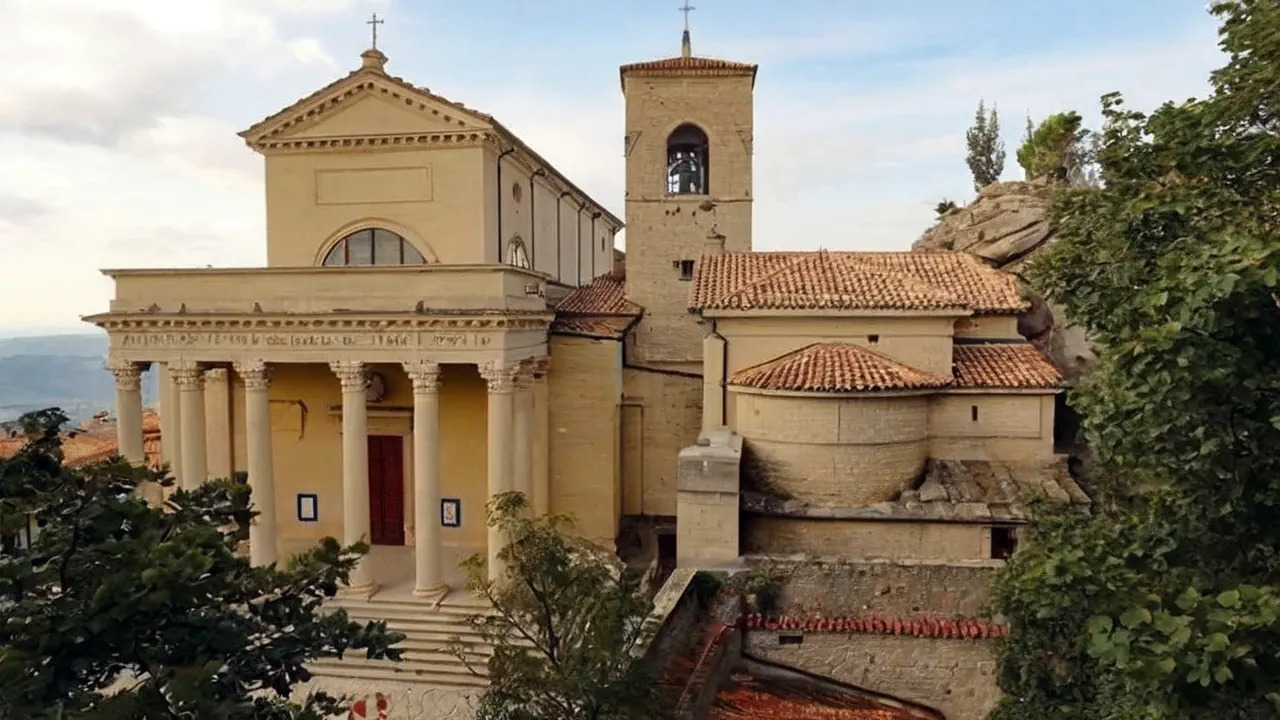
Basilica of the Saint: The main church of San Marino (19th century), housing the relics of Saint Marinus. Built in neoclassical style with Corinthian columns, it replaced a 4th-century Paleo-Christian church.

Church of San Francesco: Founded in 1361, it is the oldest religious building in San Marino.
Museums of San Marino
- National Museum: Exhibits Egyptian antiquities, Byzantine icons, 17th-century paintings, and ancient coins.
- Wax Museum: Over 100 figures of historical personalities.
- Museum of Curiosities: A quirky collection of unusual and bizarre items.
- Rosso Ferrari Museum: Vintage cars from the legendary Italian brand.
- Museum of Modern Weapons: 2,000+ firearms, ammunition, and bayonets from World Wars I and II.