<p>Explore Perugia, Umbria&#8217;s ancient capital, a city of stunning medieval architecture, Renaissance art (Perugino, Raphael), and vibrant culture. Discover attractions, history, food, and travel tips for your Italian adventure</p>
<div class="table-of-contents open"><!--noindex--><div class="table-of-contents__header"><span class="table-of-contents__hide js-table-of-contents-hide">Contents</span></div><ol class="table-of-contents__list js-table-of-contents-list">
<li class="level-1"><a href="#perugia-italy">Perugia (Italy)</a></li><li class="level-2"><a href="#geography-and-weather">Geography and Weather</a></li><li class="level-2"><a href="#practical-information">Practical Information</a></li><li class="level-2"><a href="#history-and-interesting-facts">History and Interesting Facts</a></li><li class="level-2"><a href="#how-to-get-there">How to Get There</a></li><li class="level-2"><a href="#perugia-hotels">Perugia Hotels</a></li><li class="level-2"><a href="#shopping">Shopping</a></li><li class="level-2"><a href="#food-and-drink">Food and Drink</a></li><li class="level-2"><a href="#landmarks-and-attractions">Landmarks and Attractions</a></li><li class="level-2"><a href="#video">Video</a></li></ol><!--/noindex--></div><h2 id="perugia-italy">Perugia (Italy)</h2>
<p>Perugia (Italian: <i><span lang="it">Perugia</span></i>) is a city in central <a href="https://mandry.club/en/countries/italy/">Italy</a>, the capital of the Umbria region. Nestled among the hills of the Tiber Valley, it&#8217;s renowned as the birthplace of the Umbrian School of painting. Perugia is an ancient city with a magnificent medieval historic center that has remained virtually unchanged since the 14th century, ranking among Italy&#8217;s most beautiful. Vibrant, lively, cultural, and university-oriented, Perugia is a city full of &#8220;secrets&#8221; worth exploring.</p>
<h3 id="geography-and-weather">Geography and Weather</h3>
<p>Perugia is located almost at the geographical center of Italy, between <a href="https://mandry.club/en/cities/florence/">Florence</a> and <a href="https://mandry.club/en/cities/rome/">Rome</a>. The city sprawls across the hills of the Tiber River valley. To the west lies Lake Trasimeno (one of the largest in the country).</p>
<p>The climate is subtropical. The average annual temperature is about 13 °C (ca. 55 °F). The coldest month in Perugia is January (average temperature around 4 °C/39 °F). Annual rainfall ranges between 800-900 mm.</p>
<figure id="attachment_5513" aria-describedby="caption-attachment-5513" style="width: 750px" class="wp-caption aligncenter"><a href="https://mandry.club/wp-content/uploads/2019/06/perugia03.jpg"><img class="wp-image-5513 size-large" src="https://mandry.club/wp-content/uploads/2019/06/perugia03-1024x455.jpg" alt="Panoramic view of Perugia cityscape with medieval buildings" width="750" height="333" /></a><figcaption id="caption-attachment-5513" class="wp-caption-text">Panoramic view of Perugia</figcaption></figure>
<h3 id="practical-information">Practical Information</h3>
<ul>
<li>Population &#8211; 165,600</li>
<li>Area &#8211; 449.51 square kilometers</li>
<li>Language &#8211; Italian</li>
<li>Currency &#8211; Euro</li>
<li>Visa &#8211; Schengen</li>
<li>Time zone &#8211; Central European Time UTC +1, summer +2</li>
<li>Tourist information centers are located at: Porta Nuova and Piazza Matteotti, 18</li>
</ul>
<h3 id="history-and-interesting-facts">History and Interesting Facts</h3>
<p>Many scholars believe Perugia was founded by the Umbri people. The first written records date back to the Etruscan period. Perugia was one of the 12 Etruscan city-states. In 310 BC, the city was conquered by the Romans and became the Roman colony of Perusia. In the first century BC, Perugia was burned during the military conflict between Octavian and Mark Antony.</p>
<figure id="attachment_5514" aria-describedby="caption-attachment-5514" style="width: 750px" class="wp-caption aligncenter"><a href="https://mandry.club/wp-content/uploads/2019/06/perugia02.jpg"><img class="wp-image-5514 size-large" src="https://mandry.club/wp-content/uploads/2019/06/perugia02-1024x455.jpg" alt="Aerial view of Perugia's historic center with rooftops and towers" width="750" height="333" /></a><figcaption id="caption-attachment-5514" class="wp-caption-text">Perugia</figcaption></figure>
<p>After the fall of the Roman Empire in the 6th century, the city became the center of a Lombard duchy. Later in the Middle Ages, Perugia was quite independent. Power struggles between the Oddi and Baglioni families led to numerous clashes. In the conflict between Guelphs and Ghibellines, Perugia supported the former. During various conflicts and wars, Roman Popes often found refuge and assistance within its walls.</p>
<p>During the Renaissance, Perugia became a center for the development of the Umbrian School of painting. The city gave the world artistic giants like Perugino and Raphael. In 1540, the Farnese family defeated the last of the Baglioni, and Perugia was incorporated into the Papal States. During the Napoleonic Wars, the city became the capital of the Tiberina Republic. In the 19th century, Perugia suffered from several earthquakes.</p>
<h3 id="how-to-get-there">How to Get There</h3>
<p>Perugia has an international airport serving flights from London, <a href="https://mandry.club/en/cities/barcelona-spain/">Barcelona</a>, <a href="https://mandry.club/en/cities/munich-germany/">Munich</a>, <a href="https://mandry.club/en/cities/bucharest-romania/">Bucharest</a> and other cities. Rome&#8217;s airport is about 3 hours away by car. There are regular bus and train connections to Italy&#8217;s capital and major cities.</p>

<!-- WP QUADS v. 3.0.4 Shortcode Ad -->
<div class="quads-location quads-ad17596" id="quads-ad17596" style="">
<!-- admitad.banner: yq1d7d70jj14642d67dd9b8c64f65e Infobus [CPS] WW -->
<a target="_blank" rel="nofollow" href="https://bednari.com/g/yq1d7d70jj14642d67dd9b8c64f65e/?i=4"><img width="728" height="90" border="0" src="https://ad.admitad.com/b/yq1d7d70jj14642d67dd9b8c64f65e/" alt="Infobus [CPS] WW"/></a>
<!-- /admitad.banner --></div>

<h3 id="perugia-hotels">Perugia Hotels</h3>

<!-- WP QUADS v. 3.0.4 Shortcode Ad -->
<div class="quads-location quads-ad23021" id="quads-ad23021" style="">
<!-- admitad.banner: 9culvsjipj14642d67ddf37e25e0cc Trip.com WW -->
<a target="_blank" rel="nofollow" href="https://pngkj.com/g/9culvsjipj14642d67ddf37e25e0cc/?i=4"><img width="728" height="90" border="0" src="https://ad.admitad.com/b/9culvsjipj14642d67ddf37e25e0cc/" alt="Trip.com WW"/></a>
<!-- /admitad.banner --></div>

<h3 id="shopping">Shopping</h3>
<p>Perugia has many clothing and shoe stores, including famous brands. As a university town, it&#8217;s no surprise to find excellent bookshops here.</p>
<p>Corso Vannucci is Perugia&#8217;s main shopping street. Many stores can be found around Piazza Matteotti, Via C. Fani, Via Baglioni, and Via Oberdan. The Coin shopping center, located near Piazza della Repubblica, offers a good selection of clothing and accessories.</p>
<figure id="attachment_5515" aria-describedby="caption-attachment-5515" style="width: 750px" class="wp-caption aligncenter"><a href="https://mandry.club/wp-content/uploads/2019/06/perugia01.jpg"><img class="wp-image-5515 size-large" src="https://mandry.club/wp-content/uploads/2019/06/perugia01-1024x454.jpg" alt="Scenic view of Perugia at sunset with medieval architecture" width="750" height="333" /></a><figcaption id="caption-attachment-5515" class="wp-caption-text">Panoramic view of Perugia</figcaption></figure>
<h3 id="food-and-drink">Food and Drink</h3>
<p>Umbrian cuisine is quite simple but distinguished by high-quality ingredients. The undisputed star of Umbrian cuisine is truffles. Traditional dishes include: spaghetti or strangozzi with black truffle, umbrichelli (sea bass fillet with sauce), spaghetti rancetto with bacon and cheese, pappardelle with hare and cloves, torello alla perugina, grilled meats, chicken in wine, and roasted lamb.</p>
<h3 id="landmarks-and-attractions">Landmarks and Attractions</h3>
<figure id="attachment_5516" aria-describedby="caption-attachment-5516" style="width: 750px" class="wp-caption aligncenter"><a href="https://mandry.club/wp-content/uploads/2019/06/perugia28.jpg"><img class="wp-image-5516 size-large" src="https://mandry.club/wp-content/uploads/2019/06/perugia28-1024x576.jpg" alt="Perugia city streets with medieval architecture and cobblestones" width="750" height="422" /></a><figcaption id="caption-attachment-5516" class="wp-caption-text">The city of Perugia</figcaption></figure>
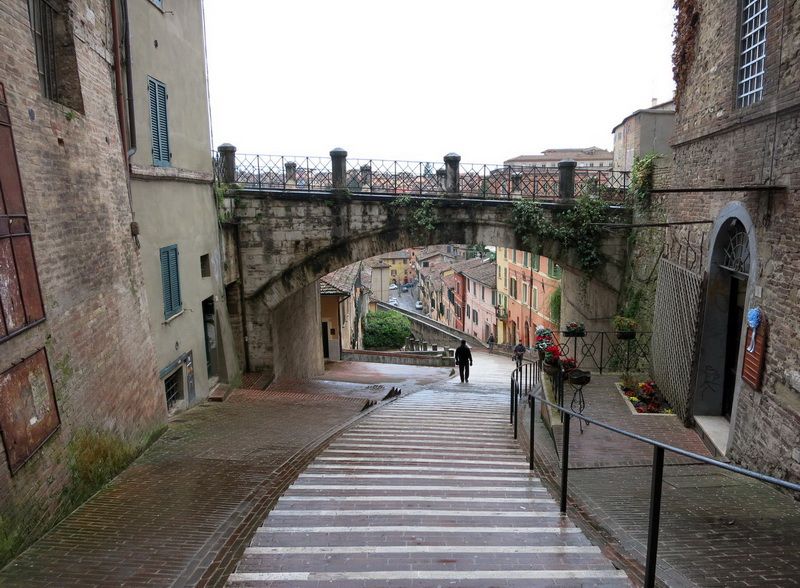
<p>Perugia&#8217;s main attractions are concentrated in the old town. The historic core has two perimeter walls. The outer wall dates from the medieval period. Perugia retains fairly large sections of medieval city fortifications and gates. The inner wall follows the perimeter of the ancient Etruscan city. Ancient Perugia had seven city gates. Fragments of Etruscan and Roman fortifications survive to this day.</p>
<figure id="attachment_5519" aria-describedby="caption-attachment-5519" style="width: 750px" class="wp-caption aligncenter"><a href="https://mandry.club/wp-content/uploads/2019/06/perugia09.jpg"><img class="wp-image-5519 size-large" src="https://mandry.club/wp-content/uploads/2019/06/perugia09-1024x458.jpg" alt="Piazza IV Novembre with historic buildings and fountain" width="750" height="335" /></a><figcaption id="caption-attachment-5519" class="wp-caption-text">Piazza IV Novembre</figcaption></figure>
<p><strong>Piazza IV Novembre</strong> &#8211; Perugia&#8217;s central square and the heart of city life since ancient times. During Roman times, this was the forum. In the Middle Ages, the square was formed where five streets converge. The piazza is surrounded by beautiful historic buildings. Its highlight is the Fontana Maggiore, built in the 13th century and considered one of Italy&#8217;s most beautiful medieval fountains. The exquisite stone sculptures were created by famous Tuscan masters, the Pisano family. On the western side stands the Archbishop&#8217;s Palace, now housing the Natural History Museum. The medieval Via delle Volte leads to Piazza Fortebraccio.</p>
<p><strong>San Lorenzo</strong> &#8211; the cathedral dedicated to one of the city&#8217;s patron saints. Built between 1345 and 1490 in Gothic style. Interestingly, both the side and main facades remain unfinished. The interior features late Gothic style, a beautiful choir, a 14th-century stone pulpit, and is divided by large columns. The sacristy, to the right of the main altar, contains 16th-century frescoes by di Pesaro. East of the cathedral is the Church of San Severo with Raphael&#8217;s frescoes.</p>
<figure id="attachment_5517" aria-describedby="caption-attachment-5517" style="width: 750px" class="wp-caption aligncenter"><a href="https://mandry.club/wp-content/uploads/2019/06/perugia04.jpg"><img class="wp-image-5517 size-large" src="https://mandry.club/wp-content/uploads/2019/06/perugia04-1024x456.jpg" alt="Palazzo dei Priori Gothic architecture facade details" width="750" height="334" /></a><figcaption id="caption-attachment-5517" class="wp-caption-text">Palazzo dei Priori</figcaption></figure>
<p><strong>Palazzo dei Priori</strong> &#8211; the most beautiful building on Perugia&#8217;s main square. This grand palace in Italian Gothic style dates from the late 13th to early 14th centuries. The griffin (symbol of Perugia), 14th-century bronze lion, and chains on the facade commemorate the victory over Siena. The first floor features a beautiful hall with ancient frescoes. Nearby is the Collegio del Cambio building with Perugino&#8217;s frescoes.</p>
<p>The third floor houses the National Gallery of Umbria, displaying works by masters of the Umbrian School &#8211; Perugino, Pinturicchio, including frescoes by Benedetto Bonfigli, plus sculptures by di Cambio and Duccio di. The gallery traces Umbrian painting from the Middle Ages to the 20th century.</p>
<p><strong>San Bernardino</strong> &#8211; a medieval oratory with a magnificent facade of colored marble, limestone, and glazed ceramics. The facade was designed by Agostino di Duccio, who also worked on Tempio Malatestiano in <a href="https://mandry.club/en/cities/rimini-the-full-guide-to-an-iconic-beach-holiday-on-the-adriatic/">Rimini</a>. The semicircular relief in the central arch is Perugia&#8217;s most important Renaissance work. Saint Bernardino of Siena, who preached here, was canonized in 1450, and local Franciscan monks built this shrine to honor him.</p>
<p><a href="https://mandry.club/wp-content/uploads/2019/06/perugia24.jpg"><img class="aligncenter wp-image-5520 size-large" src="https://mandry.club/wp-content/uploads/2019/06/perugia24-1024x576.jpg" alt="San Pietro Abbey church exterior with bell tower" width="750" height="422" /></a></p>
<p><strong>San Pietro</strong> &#8211; an early Christian church rebuilt in the 12th century. Features Gothic wooden choir stalls crafted between 1535-1591 and ancient columns, considered among Italy&#8217;s finest. The gilded wooden ceiling dates from the 16th century. The interior is decorated with frescoes and paintings by Perugino, Vasari, Reni, and others. The sacristy displays works by Raphael, Perugino, and Parmigianino. Adjacent are the namesake 14th-century gates.</p>
<p><strong>Sant&#8217;Angelo</strong> &#8211; an early Christian temple built between the 5th-6th centuries near the ancient northern gates of the same name. Incorporates 16 columns with Corinthian capitals reused from a pagan temple. The architecture shows early Romanesque with Byzantine influences. Notable early Christian symbols include a pentagram by the entrance and crosses in a style later used by the Templars.</p>
<p><strong>San Domenico</strong> &#8211; a brick Gothic church. The original structure was built in 1305, but the nave and vault collapsed in 1614. Reconstruction lasted from 1621-1634. San Domenico&#8217;s style inspired the later San Lorenzo. The church contains valuable artworks (choir stalls, remains of ancient frescoes, a beautiful altar) and the 14th-century Tomb of Pope Benedict XI, considered one of Italy&#8217;s finest Gothic tombs.</p>
<p>The adjacent former Dominican monastery houses the Archaeological Museum with rare Etruscan and Roman antiquities, some dating to the 2nd millennium BC.</p>
<p><a href="https://mandry.club/wp-content/uploads/2019/06/perugia29.jpg"><img class="aligncenter wp-image-5522 size-large" src="https://mandry.club/wp-content/uploads/2019/06/perugia29-1024x576.jpg" alt="Etruscan Arch of Augustus ancient city gate" width="750" height="422" /></a></p>
<p><strong>Arch of Augustus</strong> &#8211; an ancient Etruscan arch built in the 3rd century BC and restored under Emperor Augustus in the 1st century BC (after whom it was renamed). The inscription &#8220;Augusta Perusia&#8221; dates from this period. Augustus only captured Perugia after a 7-month siege. The gate arches connect two trapezoidal towers. The upper loggia was added during the Renaissance, and the fountain was completed in 1621.</p>
<figure id="attachment_5523" aria-describedby="caption-attachment-5523" style="width: 750px" class="wp-caption aligncenter"><a href="https://mandry.club/wp-content/uploads/2019/06/perugia27.jpg"><img class="wp-image-5523 size-large" src="https://mandry.club/wp-content/uploads/2019/06/perugia27-1024x576.jpg" alt="Rocca Paolina fortress ruins and underground passages" width="750" height="422" /></a><figcaption id="caption-attachment-5523" class="wp-caption-text">Rocca Paolina</figcaption></figure>
<p><strong>Rocca Paolina</strong> &#8211; an ancient fortress and symbol of papal power until 1860. Built by order of Pope Paul III to create a safe refuge in Perugia, like Castel Sant&#8217;Angelo in Rome. Over 100 buildings (mostly belonging to the hated Baglioni family) were demolished for its construction. After Italian unification, most of the fortress was demolished. Only part of the bastion remains today.</p>
<p><strong>Etruscan Well</strong> &#8211; a 37-meter-deep, 5-meter-diameter well dating from the 3rd-4th century BC. This massive structure served as a water reservoir. Open to visitors, its bottom and walls are lined with travertine. Located on Piazza Danti.</p>
<h3 id="video">Video</h3>
<p><amp-youtube width="640" height="360" layout="responsive" data-videoid="6p3GNq0lnUo"><amp-img src="https://i.ytimg.com/vi/6p3GNq0lnUo/hqdefault_live.jpg" placeholder layout="fill" /></amp-youtube></p>
We'll explain what stars are, how they shine, and why we can't see them during…
A well-packed suitcase is one of the key ingredients for a successful trip. Taking everything…
By Tony Wooding People often ask me what my dream holiday is. Most expect the…
The hospitality industry in Turkey is one of the best in the world. And this…
The majority of hotels worldwide are geared toward family vacations: they offer entertainment for children,…
Is there salt in raindrops, why do the seas remain salty if so many freshwater…
