Heidelberg — a detailed tourist guide with photos and a map. The main sights of Heidelberg, useful information for travel and recreation.
The City of Heidelberg (Germany)
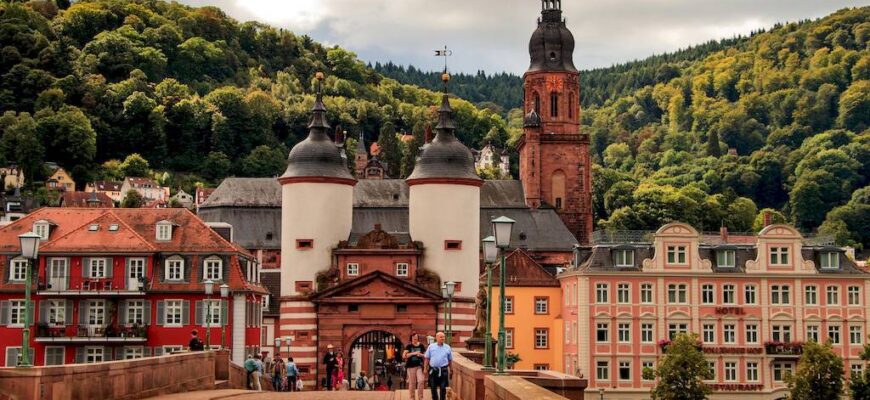
Heidelberg (German: Heidelberg) is a city in southwestern Germany in the federal state of Baden-Württemberg. It is located in the Neckar River valley among the picturesque, forest-covered hills of the Odenwald. Heidelberg is one of the most romantic cities in Germany, with a beautiful historic center dominated by the ruins of an ancient castle. It is full of charming historic places and sights, narrow streets and old houses, as well as excellent restaurants and beer halls.
Heidelberg is the old capital of the historic region of the Palatinate and an ancient university city, celebrated by German poets. It is located at the point where the Neckar River flows out of the Odenwald hills, following into the Rhine valley. This is the perfect place to experience the picturesque beauty of forests and hills, the atmosphere of the old town, and the romance of ancient ruins.
Geography and climate
Heidelberg is located on the banks of the Neckar River and is surrounded by the hills of the Odenwald. The city lies in a picturesque forested valley, surrounded by three high hills. The highest point is Königstuhl (568 m). Heidelberg is one of the warmest cities in Germany. Almonds and dates grow here, and there is also a wild population of parrots.
A notable place in Heidelberg is Heiligenberg, or the Mountain of All Saints. It rises above the city on the northern bank of the Neckar River and is famous for its wonderful view of the river valley. A two-kilometer path called the “Philosophers’ Way” leads to its summit. Heiligenberg has been an important defensive outpost since ancient times. Here are the ruins of medieval monasteries, an ancient Roman temple, and a Celtic fort built in the 4th century BC. Here you can also see an open-air theater built during the Third Reich.

Practical information
- Population – 150.3 thousand.
- Area – 108.89 km².
- Currency — euro.
- Language — German.
- Visa — Schengen.
- Time — Central European UTC +1.
- Heidelberg is a very safe city. However, at night it is better to avoid walking alone along the northern bank of the Neckar River, where there are plenty of students having fun.
History
The surroundings of Heidelberg were settled in the 6th-8th centuries. The first mentions of the city date back to 1196. In 1225, the fortress of the same name was founded. In the 14th century, the university was founded in Heidelberg — one of the oldest and most respected educational institutions in Europe.

During the Thirty Years’ War, Heidelberg was conquered by the troops of the Holy Roman Empire. At the end of the 17th century, the city was devastated by the French, who also destroyed the Old Castle. In 1720, Heidelberg ceased to be the capital of the Electorate of the Palatinate, which was moved to Mannheim. And at the beginning of the 19th century, the city was included in the region of Baden.
Heidelberg is one of the few cities in Germany (like, for example, the historic cities of Bavaria — Regensburg and Bamberg) that was not touched by World War II. This allowed the historic core to be preserved in wonderful original condition.
How to get there
The nearest airports are located in Frankfurt am Main and Stuttgart. Heidelberg is a major railway hub, connected by regular service (including high-speed) with Munich, Karlsruhe, Frankfurt am Main, Stuttgart, Paris, Vienna, Hamburg, Cologne, Zurich, Amsterdam, and other European cities.
Shopping and purchases
The main shopping area is concentrated around Bismarckplatz and Hauptstraße street. Souvenirs can be bought in the vicinity of the cathedral.
Heidelberg, Old Town
Cuisine
On the northern bank of the Neckar River (Neckarwiese) there are many cozy beer halls with a beautiful view of the castle. Along Hauptstraße you can find many inexpensive bakeries with traditional pastries and good restaurants. Heidelberg, thanks to tourists and students, has more than 300 bars, restaurants, and cafes. Here you can find both youth clubs and bars that are open almost until morning, as well as traditional German beer restaurants.
Sights

Heidelberg has a wonderful Old Town, or Altstadt, which has been preserved in excellent condition. The historic center has a predominantly Baroque appearance, in which the city was rebuilt after being devastated by the French at the end of the 17th century. Heidelberg’s Altstadt is an interweaving of ancient narrow streets, lively squares, ancient churches, and architectural monuments, above which rise the significant ruins of the old castle.

Heidelberg Castle — the most famous sight of the city and a masterpiece of German Renaissance architecture. It is a significant structure made of red sandstone, built in the 16th century on the 200-meter slope of the hill. Heidelberg Castle was founded in the 13th century as a military fortress. In the 15th and 16th centuries, it was transformed into a palace for the local electors. After its destruction by the French, who devastated the Palatinate in the 17th century, it was abandoned. Today Heidelberg Castle is considered one of the most picturesque ruins in Germany.
The famous castle is located on the slopes of Königstuhl — the second highest peak of the Odenwald. The Historic Funicular will take you to the summit, from where a breathtaking view of the Neckar River valley and the Black Forest opens up.

Alte Brücke (Old Bridge) – a picturesque stone bridge built in the 18th century during the reign of Elector Karl Theodor. It connects the two banks of the Neckar River and is famous for its beautiful sculptures.
If you are traveling with children, then in Heidelberg be sure to visit the zoo, located on the northern bank of the Neckar River. It houses more than 1,100 animals. Also here is the oldest Botanical Garden in Germany.

Old University — the oldest educational institution in Germany, founded in 1386. The old university building dates back to the 18th century. Here is the rector’s office, a museum, and the famous Student Prison (Studentenkarzer), where students were imprisoned for minor offenses.

Kornmarkt — the historic square of the old grain market and one of the liveliest places in Heidelberg. In the 16th century, a hospital managed by Catholics was founded here. In the 17th century, the Jesuits installed the main landmark of this place — a statue known as the Madonna on the Grain Market. Today it is considered a wonderful work of Baroque art.

Marktplatz — the lively Market Square, which has been the center of city life since the Middle Ages. Here are such interesting sights as: the Church of the Holy Spirit, the town hall, built at the beginning of the 18th century, and a fountain with a Baroque statue of Hercules.
Church of the Holy Spirit — the main religious building of Heidelberg, founded in the 13th century. In the 15th century, the church acquired its modern late Gothic appearance. The Baroque bell tower spire was added several centuries later. Over the centuries, this building was the burial place of the Electors of the Palatinate. To this day, only the tomb of the 15th-century King of Germany Rupert has survived. The remaining 53 tombs were destroyed by the French in the 18th century.

Knight’s House — the oldest and most beautiful burgher’s house in Heidelberg, built in 1592 for the cloth merchants Franziska and Carolus Weiss.
Church of St. Boniface — a Catholic Neo-Gothic basilica in the western part of Heidelberg, built between 1899-1903.
Providenzkirche — a Lutheran church with a Baroque bell tower, built in the first half of the 19th century. It is located on the main street (Hauptstraße).

Jesuit Church — the main Catholic church of Heidelberg, located next to the Church of the Holy Spirit, which is now Protestant. It is a significant red sandstone building built in the 18th century. The tall Neo-Baroque bell tower was added in the second half of the 19th century. Adjacent to the church building is a museum of sacred art and liturgy.
Church of St. Anna — a Baroque religious building located in the Old Town. The church was built between 1714 and 1717 east of the old hospital.
Church of St. Raphael — a Catholic church in the Neo-Romanesque style, built between 1903 and 1905. It is located in the Neuenheim district.